EPA reports progress on Tijuana River sewage infrastructure

The U.S. Environmental Protection Agency (EPA) and Mexico have advanced several wastewater infrastructure projects aimed at reducing sewage flows into the Tijuana River and improving treatment capacity along the U.S.-Mexico border.
In its third-quarter 2026 update, EPA reported that the Parallel Gravity Line was completed in August and construction began on Phase 2 of the Tijuana River Gates. The first major construction contract for expanding the South Bay International Wastewater Treatment Plant (SBIWTP) to 50 million gallons per day (MGD) was awarded in September. The plant’s capacity was previously expanded to 35 MGD in August 2025.
The U.S. International Boundary and Water Commission is also preparing the full design for the SBIWTP expansion, with approval expected in October. Early work is underway to maintain the existing plant and prepare for construction.
On the Mexico side, rehabilitation advanced on four degraded sewage conveyance lines. As of the quarterly update, construction had reached 460 meters of the 705-meter Poniente Interceptor, 421 of 1,600 meters of the Oriente Interceptor, 986 of 1,100 meters of the Carranza Collector and 205 of 5,431 meters of the Insurgentes Collector.
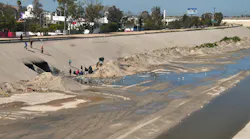
Crews also cleared approximately 16,622 feet of the Tijuana River pilot channel in preparation for the wet-weather season. EPA and USIBWC are coordinating with agencies in San Diego and Tijuana to assess infrastructure ahead of a potentially strong El Niño winter.
Additional projects include rehabilitation of the Antiguo Force Main and Pump Station 1, relocation of 10 MGD of treated effluent from two Tijuana wastewater treatment plants to the Rodríguez Reservoir and rehabilitation of the Matadero and Laureles II pump stations. Mexico also hosted a binational stormwater workshop in July as part of commitments under Minute 333, the 2025 U.S.-Mexico agreement addressing the border sanitation problem.