What is water reuse and reclamation?
Key Highlights
- Also known as water reclamation and water recycling according to the EPA, water reuse refers to the treatment and repurposing of wastewater or stormwater for uses including for land irrigation and drinking water.
- Some of the common applications of reclaimed water is for drinking water, as stormwater to reduce pollution, for cooling systems at data centers, for industrial operations such as mining, and for farm irrigation.
- Advanced membrane and disinfection are some of the technologies to enable water reuse.
- The EPA’s National Pollutant Discharge Elimination System (NPDES) permit, the Safe Drinking Water Act, and the Clean Water Act govern water reuse.
- The Water Reuse Action Plan (WRAP) 2.0 aims to deepen existing partnerships and to build new relationships with the objectives to accelerate the adoption of water reuse, ensure the cleaning and purification of wastewater for specific intended uses, and to enhance strategic partnerships to support states and Tribes.
- Valued at $29.76 billion in 2025, the US water recycle and reuse market is projected to reach $58.13 billion by 2034, representing a 7.7% compound annual growth rate, due to the efforts in adopting reclaimed water systems for industrial facilities and urban infrastructure projects.
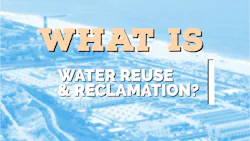
The aerial view of the Stickney Water Reclamation Plant, one of the largest wastewater treatment facilities in the world, shows gigantic rectangular and circular structures against the backdrop of the Chicago buildings. In operation since 1930, the Stickney Water Reclamation Plant serves over 2.2 million people and cleans an average of about 700 million gallons of wastewater per day – much higher than the average water reclamation plant in the state of Illinois that treats one million gallons per day.
The wastewater undergoes primary, secondary, and tertiary treatments with the goal to reduce contaminants in the water including suspended solids, nutrients such as phosphorus and nitrogen, and pathogenic bacteria – only taking about 12 hours from raw sewage to clean water according to their fact sheet.
Regulated under the EPA’s National Pollutant Discharge Elimination System (NPDES) permit program that sets rigorous standards for the discharge of treated water, Stickney Water Reclamation Plant, owned and operated by the Metropolitan Water Reclamation District of Greater Chicago, has been recognized consistently for compliance with these standards. The district received the Platinum 5 Peak Performance award recently in 2025 for compliance with the NPDES permits.
Besides recovering more than 85% phosphorus and up to 15% nitrogen using its mega-size reactors, the Stickney Water Reclamation Plant benefits the communities by providing them with clean recreational water and a rebounding aquatic habitat.
What is water reclamation?
Also known as water reclamation and water recycling according to the EPA, water reuse refers to the treatment and repurposing of wastewater or stormwater for uses including for land irrigation and drinking water.
Playing an integral role in water reuse are wastewater treatment and drinking water facilities and here is how: wastewater treatment facilities and advanced treatment facilities remove harmful chemicals and microorganisms from the water for land use while drinking water treatment facilities further remove these and other harmful components to supply drinking water.
Definition of water reuse
Some examples of state definitions of water reuse are as follows:
- Water reuse in Alabama administrative code Rule 335-6-20-.02 (28) means the use of reclaimed water in lieu of other water sources for irrigation to benefit areas including golf courses and parks.
This administrative code defines reclaimed water as wastewater that has received treatment and meets the defined criteria, which at the minimum is secondary treatment or alternative treatment provided in 40 CFR Part 133.
- In Virginia, the definition of water reuse in Administrative Code 9VAC25-740-10 is reclaimed water that is used for a direct beneficial use, an indirect potable reuse, an indirect nonpotable reuse, or a controlled use.
According to this administrative code, reclaimed water means treated domestic, municipal or industrial water that is suitable for reuse. Excluded from this definition is “gray water”, "harvested rainwater" and "stormwater".
What is the difference between water reuse and water recycling?
In both the Alabama and the Virginia’s definitions, water reuse is reclaimed water. This also holds for the EPA’s definition of water reuse as well.
According to the EPA, water reuse is also referred to as water reclamation and water recycling. Therefore, water reuse is also water recycling.
What are common applications of reclaimed water?
One of the applications of reclaimed water (also known as recycled water by the EPA), provided as an example by the EPA, is for drinking water. The following are summarized steps for how wastewater becomes reclaimed water and then drinking water:
- After undergoing wastewater treatment, the treated wastewater is subjected to advanced treatment to remove harmful chemicals and microorganisms.
- The resulting highly treated water, now reclaimed water, enters water bodies such as lakes, streams, and reservoirs.
- Before it could be used for drinking water delivered in utility pipes for communities, it undergoes drinking water treatment to remove harmful chemicals and microorganisms for compliance with the Safe Drinking Water Act.
Other uses of recycled water are:
- As stormwater to reduce pollution
- For cooling systems at data centers
- For industrial operations such as mining
- For farm irrigation
Did you know?
The City of Wichita is developing a water reuse plan to investigate non-potable reuse (water that can be used for non-drinking water applications) and potable reuse due to drastic changes in Cheney’s water level during the summer.
What technologies enable water reuse?
The most common technologies to enable water reuse are:
- Advanced membrane and filter technologies to remove chemicals and microorganisms.
- Disinfection using chlorine, ultraviolet radiation, or ozone to destroy microorganisms.
The above technologies can be used repeatedly in several stages of water treatment. For example, to use recycled water as drinking water, filter and disinfection technologies are used in wastewater treatment facilities and at drinking water treatment facilities.
Depending on the utility provider, the recycled water could be supplemented with minerals and adjusted for pH to prevent corrosion in the utility pipes.
What regulations govern water reuse and reclamation?
While some states have incorporated programs for water reuse in their regulatory frameworks, the EPA enforces the Safe Drinking Water Act and the Clean Water Act to protect the quality of drinking water and waterbodies. In other words, the quality of reused water is governed by the Safe Drinking Water Act and the Clean Water Act.
Why? Because the definition of water reuse is treated water that is used for applications such as for irrigation and in some places, as drinking water. From irrigation, reused water enters water bodies. For use as drinking water, treated water is subjected to stringent water treatment.
Therefore, the above Acts enforce the quality of water to protect public health.
Additionally, NPDES permits also govern water reuse. There are effluent limitations (meaning there are limitation on the maximum allowable concentration of a pollutant that can be discharged into the environment) and the NPDES permits regulate the discharge of pollutants from point sources into the receiving waters of the United States.
An example of discharge that is regulated by the NPDES permit is the discharge of treated water from the Stickney Water Reclamation Plant into the Chicago Sanitary and Ship Canal.
Additionally, California passed direct potable reuse (DPR) rules, establishing the first state-level legal framework for DPR in the country. Other states such as Arizona, Florida, and Texas are also in the process of promulgating their own legal frameworks for DPR.
Water Reuse Action Plan 2.0
The National Water Reuse Action Plan (WRAP), developed in collaboration with partners in the water sector and announced in 2020, was intended to support and address the adoption of water reuse (potable and nonpotable).
Built on this foundation, the EPA released the Water Reuse Action Plan (WRAP) 2.0 on April 16, 2026 to deepen existing partnerships and to build new relationships with the objectives to:
- Accelerate the adoption of water reuse to lower the costs and to ensure a reliable supply of reclaimed water for sectors that are vital to the economy including for microchip fabrications and data centers.
- Ensure the cleaning and purification of wastewater for specific intended uses through initiatives. These include exploring the use of digital solutions to improve the real-time monitoring of water treatment.
- To enhance strategic partnerships and technical expertise to support states and Tribes. This will identify barriers and the best practices to advance water reuse strategies.
REUSExplorer
REUSExplorer is a tool developed by the EPA and its partners as part of WRAP. It allows users to select the state or country, sources of water, and the reuse application. Clicking on the links in the results redirect the user to additional information on the water reuse.
Additionally, the REUSExplorer also includes maps of states with reuse regulations or guidelines. These include water reuse for industrial purposes and for environmental restoration.
Looking ahead
Valued at $29.79 billion in 2025, the US water recycle and reuse market is projected to reach $58.13 billion by 2034, representing a 7.7% compound annual growth rate, due to the efforts in adopting reclaimed water systems for industrial facilities and urban infrastructure projects.
Emphasis on water reuse was one of the core topics at WEFTEC 2026 presented in one of the key themes, Circular Water Economy. According to WEFTEC, this theme reimagines water as a renewable, regenerative resource that can be used to recover water, nutrients, and energy besides reducing waste and regenerating the natural environment.
The pavilion on this theme brought together experts including on legislations and partnerships for advancing the circular water economy.
Circular water economy can be broadly understood as a focus on reducing water usage and wastage, recovering energy and nutrients from wastewater, and regenerating water to restore the natural systems
And this is not all.
On September 15, 2026 the EPA launched the G20 Water Reuse Initiative built on a “fit-for-purpose” approach grounded in rigorous science rather than a one-fit-for-all approach for water reuse and related technologies.
The G20 Water Reuse Initiative recognizes that water reuse, besides water desalination and other technologies aimed at water sustainability, can reduce operational impacts, enhance energy performance, and improve water resilience in the long-term.
One of the reasons for the increasing demand of water reuse is data centers – the concern about their water consumption.
"It would be possible here to use treated water reuse not only in data centers but also industrial settings," said John Murray, Executive Director of the Metropolitan Water Reclamation District, referring to the use of treated wastewater from its Calumet plant for data centers.
No wonder, there is heavy attention on water reuse.
About the Author
 Saleha Kuzniewski
Saleha Kuzniewski, Ph.D. has authored several publications in the fields of scientific research, biotechnology, and environmental regulations. She is the winner of the 2023 Apex award for publication excellence. She is also the founder of Environmental Remediation & Innovations, LLC. Kuzniewski can be reached at [email protected].