Managing odor hotspots in wastewater collection systems
Key Highlights
- Odor issues often originate upstream in long sewers, force mains, and pumping stations due to sulfide buildup and anaerobic conditions.
- Effective odor control requires matching technology to the source, with options like biofilters for enclosed air streams and atomization for open, intermittent sources.
- Site layout, seasonal variations, and operational practices influence odor dispersion and control effectiveness, necessitating site-specific strategies.
Odor management remains a persistent challenge for water and wastewater treatment professionals. Treatment works often take the blame for odors detected at the point of wastewater arrival, where odors are more noticeable and easiest to detect, despite the fact they tend to develop earlier in the network, such as in long sewers, force mains or pumping stations. Nuisance odor is both an operational issue and a community issue and site teams are expected to respond. Supporting effective odor management requires the targeted application of source-level technologies, informed by the way in which odors develop travel and are released within water and wastewater systems.
Why odors originate upstream
One of the main causes of odor at water and wastewater sites is the buildup of odorous compounds such as sulfides during transportation, which are released at locations where wastewater is disturbed or exposed to air. Slow-moving sewage, long retention times, grease accumulation and septic conditions all increase the likelihood of sulfide formation, notably hydrogen sulfide which is associated with nuisance odor, worker safety concerns and corrosion. Technical reviews of sewerage systems continue to identify anaerobic conditions and sulfate-reducing bacteria that reduce sulfate to hydrogen sulfide as the main drivers of hydrogen sulfide generation in wastewater networks[i].
In North America, large, distributed sewer networks and extensive use of force mains can significantly increase wastewater travel time which, in turn, increases the likelihood of sulfide formation. In many systems, aging infrastructure, unreliable maintenance regimes and the disposal of fats, oils and grease contribute to the conditions that promote septicity. These upstream processes have direct operational and regulatory implications. Hydrogen sulfide is a leading cause of corrosion in concrete sewers, which can cost billions of dollars a year, and can reduce the structural lifespan of sewer networks to between ten and twenty years.
Where odors are most noticeable on site
Odor hotspots at water and wastewater treatment works are most commonly associated with inlet and headworks areas, open tanks, sludge thickening, biosolids handling zones, and locations with limited natural ventilation. A review of wastewater odor abatement technologies indicates that pre-treatment units and sludge handling areas are consistently among the most important sources because they combine high odor potential with frequent air release.[ii] Site layout also plays a significant role, with low-lying areas, open channels and boundaries nearby to receptors, all making the same level of emission more noticeable.
Seasonal variation adds another layer of complexity for odor management, with warmer summer temperatures in many regions worsening local odor conditions. The acceleration of biological activity increases the rate of hydrogen sulfide formation before wastewater even reaches the treatment plant.
Odor control strategies: Targeted solutions make all the difference

The way odors form and evolve upstream helps to explain why a single control strategy often produces uneven results. Odors from enclosed, ducted air streams behave differently from odors released intermittently from open process areas or from parts of the sewer network that cannot be easily enclosed. A control measure may perform well where airflow is captured and consistent, but less well if emissions vary with loading, weather or operational changes. Effective odor management therefore depends on matching the control method to the source rather than applying the same response across an entire site.
Established odor controls for enclosed or extractable sources include biofilters, biotrickling filters and chemical scrubbers. In wastewater treatment plants, biofilters and biotrickling filters are the most widely applied options at full scale2, mainly because they can deliver high removal performance with comparatively lower operating costs when air capture is feasible. A recent study monitoring odor removal via high-speed biofiltration in headwork operations, reported hydrogen sulfide removal efficiencies of 87.5% to 98.9% for biofiltration under tested conditions,[iii] illustrating why these approaches remain standard practice for contained air streams. Their limitation however is that they depend on containment, extraction and relatively stable airflow.
Treating open and intermittent odor sources
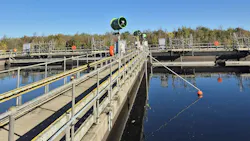
Mobile source-level misting or atomization offers effective odor control for open sources that are exposed to all weather conditions. This control may include atomizers over open primary settlement tanks, lagoons or sludge handling areas, with mobile units deployed rapidly to specific release points during maintenance or peak loading.
Stack or exhaust spraying can provide an additional polishing stage in enclosed treatment systems already using biofilters or scrubbers, to introduce ultra-fine droplets into the exhaust air stream where they interact with residual odor compounds before discharge. This vapor-phase interaction allows odor neutralization with minimal liquid release inside ductwork or stacks during periods of high load and maintenance when primary abatement systems may be under strain. System selection must consider airflow, temperature, evaporation rate and wetting tolerance to ensure effective performance without creating drainage or maintenance issues.
 dreamstime_xxl_216817036
Getting system design right
Any localized odor control treatment on wastewater sites must not create secondary operational problems. Over-wetting can increase runoff and interfere with sludge or biosolids handling, making application rate, droplet size, placement and operating schedule matter as much as the treatment chemistry itself.
Experience across industrial and waste applications shows that odor systems perform best when placed at the source and when they are designed to address specific airborne contaminant behaviour. Well-specified systems can reduce complaints, support compliance and lower the operational burden, whereas poorly specified ones often add maintenance without solving the underlying issue.
In practice, the most reliable approach is site-specific. Different locations may need different controls, which typically also need seasonal adjustment. Complaints are less likely when operators identify where odors form, where they are released and how they move across the site, then match interventions accordingly.
Meeting operational and community expectations
Odor complaints are subject to increasing scrutiny from regulators and local communities, particularly in densely populated or rapidly expanding urban areas. As a result, utility companies are also under growing pressure to understand and manage odor at its source within the collection system, rather than relying solely on treatment at the plant.
Site operators are looking to reduce complaints through reliable and effective control of site conditions, against the backdrop of a wider public scrutiny of wastewater performance. Although odor is only one part of the picture, it remains one of the most immediate ways in which wastewater operations are experienced by nearby communities. A professional odor strategy implemented on a site by site basis will help manage community complaints, comply with air quality guidelines, and ensure continued operation.
References
- Zhang, L., et al. 2023. “Hydrogen Sulfide Control in Sewer Systems: A Critical Review of Recent Progress.” Water Research.
- Senatore, V., et al. 2021. “Full-Scale Odor Abatement Technologies in Wastewater Treatment Plants (WWTPs): A Review.” Water 13 (24): 3503.
- Hernandez-Shek, M. A., et al. 2025. “Odor Removal via High-Speed Biofiltration in Headwork Operations of Wastewater Treatment Plants.” Water Science and Technology.
About the Author
 Victoria Taylor
Victoria Taylor
As CEO of Probe Industries, Victoria Taylor has spent over two decades proving that clean air, worker wellbeing, and commercial success can go hand in hand. Her journey blends business, science and a lifelong curiosity about how things work. After gaining an MBA from Newcastle University, she represents the university worldwide while expanding Probe Industries’ global footprint.