From rotten eggs to happy neighbors: Solving collection system odors
Key Highlights
- Hydrogen sulfide (H2S) is the primary cause of sewer odors, produced by sulfate-reducing bacteria in anaerobic conditions within the sewer system.
- Odor investigations involve measuring parameters like H2S levels, air pressure, wastewater sulfide concentrations, pH, and flow to identify sources and inform control strategies.
- Odor mitigation methods include sewer cleaning, chemical injection, manhole sealing, and the use of activated carbon inserts to absorb odorous compounds.
- Preventative measures such as roof vent filters, p-trap maintenance, and lateral inspections help reduce the escape of sewer gases into residential areas.
- Regular monitoring and maintenance are essential for effective odor control, infrastructure protection, and maintaining positive community relations.

Odor control in wastewater treatment is often focused on the plant itself, but with increasing water efficiency use regulations resulting in lower, more concentrated flows and longer hydraulic retention times in the collection system, manholes can be a significant source of unpleasant smells.
These odors not only cause discomfort for nearby residents but can also indicate underlying chemical and biological processes that may lead to expensive infrastructure corrosion. This article explores the science behind these odors, detection methods, and technologies and operating approaches to successfully mitigate odor and corrosion in your neighborhoods.
The chemistry of complaints – what’s really happening in your sewers
The characteristic “rotten egg” smell emanating from manholes primarily results from hydrogen sulfide (H2S) production, though other volatile organic compounds (VOCs) and reduced sulfur compounds such as mercaptans or dimethylsulfides, also contribute to the overall odor profile. This biochemical process occurs when sulfate-reducing bacteria thrive in the anaerobic conditions commonly found in sewer systems (Fig. 1).
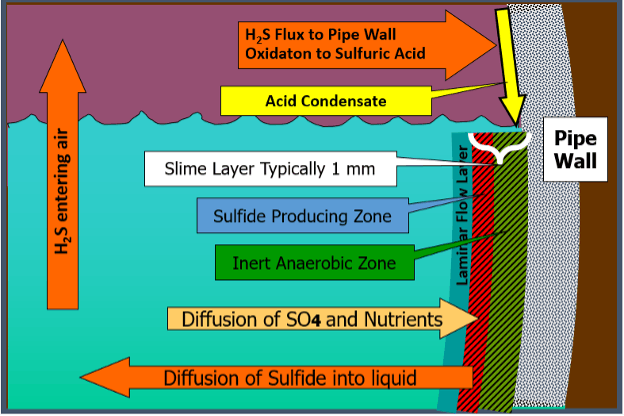
Volatilization of these compounds into the headspace of the sewer system occurs naturally, but is accelerated in turbulent zones, such as slope changes, pipe diameter changes, drop manholes, siphons, manhole junctions or pipe confluences. Once the odorous gases are in the headspace, it requires positive pressure to force them out of manhole covers or into home laterals. H2S has an extremely low odor detection threshold of 0.0005 ppm, explaining the many odor complaints received across the country.
Playing detective – your odor investigation toolkit
Understanding the root causes of an odor problem, a crucial first step to implementing an effective solution, often requires some detective work. Several parameters should be assessed.
Odor source: Confirm that odors are escaping from manholes as opposed to adjacent laterals or even roof vents, suggesting more of a plumbing or homeowner problem.
Sewer profile: Understanding the dynamics within the sewer pipeline will help with the investigation and selection of a technology to address odors.
Hydrogen sulfide: H2S can be measured in the air within select manholes as it is typically a dominant odorant in wastewater systems.
Air Pressure: Differential pressure gauges measure the relative pressure within manholes to identify if air is being ‘pushed’ out of or ‘pulled’ into the manhole. Positive pressure readings indicate that air is moving out of the manhole and potentially into laterals or through manhole covers. Ideally, sewer flow would ‘pull’ air and odors with it along the pipe preventing any escape of H2S outside of the sewer environment.
Wastewater sulfide: Sulfide concentrations in wastewater are indicative of release potential and should therefore be measured. Concentrations greater than 1.0 to 1.5 mg/L may contribute to odor and corrosion problems. Dissolved sulfide concentrations are also required to choose an effective chemical treatment solution.
Wastewater pH and carbonaceous biological oxygen demand (cBOD): Wastewater pH can impact H2S release, with higher pH suppressing release, while cBOD can affect H2S generation. Waste streams with high oxygen demand tend to favor the anaerobic bacteria that are responsible for H2S generation.
Wastewater flow: Wastewater flow volumes can impact turbulence and are needed to estimate dosing quantities for any chemical injection solution considered. Flow monitoring in a gravity sewer should be performed in a straight pipe section with laminar flow and little turbulence.
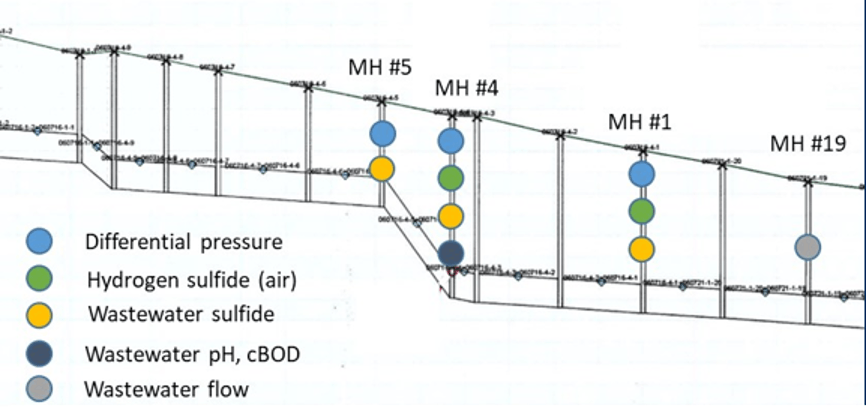
Depending on the odor complaint location and sewer profile, the sampling and measurement locations need to be carefully selected. One example can be found in Figure 2 below, where MH #1 indicates the odor complaint location, MH #4 and #5 are directly down and upstream of an area of turbulence, and MH #19 was selected for its laminar flow and flow monitoring (Fig. 2).
Fighting back sewer odors with proven strategies that work
Based on the results of the odor investigations, several solutions can be explored that range from reducing sulfide generation in the sewer to preventing H2S movement out of the sewer.
Reducing H2S Generation.
Sewer cleaning: Regular scouring of the pipes in question can remove the biological slime layer where H2S is generated. Through monitoring H2S levels in the sewer with dataloggers, it may be possible to define an optimized schedule to reduce H2S generation. This approach could be mixed with intermittent caustic “shock dosing” (the periodic dosing of sodium hydroxide to kill the slime layer) to potentially provide greater odor control.
Chemical injection: Injecting chemicals into the wastewater can be used to prevent H2S generation. Figure 3 highlights the categories of chemicals typically used and the features of each (Fig. 3).
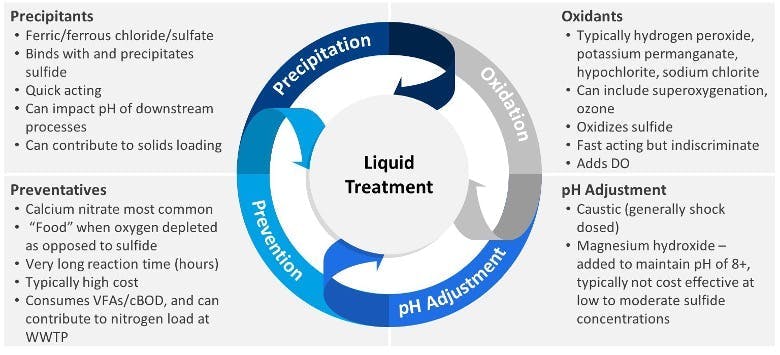
Dosing quantities and the relative merit of the various chemicals is difficult to ascertain based upon literature values or experience at other facilities. However, “jar testing,” which is adding the chemical to wastewater and measuring H2S reduction, is usually performed to determine which chemicals might be most cost-effective. Jar testing is then followed by full-scale demonstration tests to verify jar test findings.
Another key consideration is identifying a location for dosing. Some chemicals require a long reaction time, while others may have a very low pH or other characteristics that make them unsuitable for application in some residential areas.
Preventing H2S Movement out of the Sewer.
Manhole sealing: Silicone sealing manhole lids and vents will physically inhibit the ability for H2S gas to escape into the atmosphere along the street. This alternative can have adverse effects, however, as the H2S may build up in the manholes expediting corrosion and degradation. Additionally, the gas may escape from the sewer system through other pathways which can include going through sewer laterals into residents’ homes.
Manhole inserts: Manhole inserts are essentially containers filled with activated carbon or other adsorbents that are mounted below manhole lids. The carbon media absorbs odorants that are pushed up through the manhole by positive pressure in the sewer. These inserts are effective at capturing odors that would otherwise escape into the atmosphere. Over time, however, the carbon will become saturated with removed compounds and will require replacement. The frequency varies and is impacted significantly by H2S concentrations: the higher the H2S concentration, the more frequently the media will need to be replaced. Periodic monitoring of insert performance is recommended to ensure that the media is replaced when (or soon before) it is expended.
Lateral/clean out care: Laterals and sewer clean outs in yards can be damaged by landscaping or by tree roots. Visual inspections by homeowners can sometimes identify damage, but CCTV inspection may be needed to identify pipe breakages or root intrusions that could serve as an escape outlet for odors. Smoke tests could also help identify lateral damage.
Roof vent filters: Plumbing systems require roof vents to allow air into the system to prevent a vacuum in the pipes from forming. Typically, no gas barrier exists between these vents and the sewer. In quiescent air conditions (often early morning and evening), H2S gas, which is heavier than air, may “sink” to the yard and street level and result in nuisance issues. Adding carbon filters to the vents would not inhibit their function but would remove any H2S that might be passing from them.
Residential home p-trap care: P-traps are located at each drain (including sinks, toilets, tubs, etc.) within residential homes to prevent sewer gases from entering the home. These p-traps have been known to dry out during periods of low use or in dry climates, especially in non-primary residences. Reaching out to homeowners and recommending to flush all toilets and run water down each drain periodically can refill these p-traps and eliminate pathways for sewer gases to enter the home.
Smoke testing: One approach to determine if sewer gas is escaping through drains is to perform a smoke test. Smoke testing releases non-hazardous, non-flammable colored gas within the sewer environment to visually see movement within the sewer and locations where gas can escape. The smoke is a low density so it will naturally rise through cracks, gaps, and openings within the sewer environment. Homeowners in the area should be notified before smoke testing.
Every odor complaint represents both a community relations challenge and a warning sign of potential infrastructure damage. By treating collection system odors as seriously as treatment plant emissions, utilities can protect both their assets and their reputation, one manhole at a time.
About the Author
Lynne Moss
Lynne Moss is a residuals and odor control practice leader in Gaithersburg, Maryland.