President Trump calls for federal response to Potomac Interceptor collapse
The News in Brief
- The Potomac Interceptor, over 60 years old, experienced a collapse that released 243 million gallons of untreated wastewater into the Potomac River.
- DC Water quickly developed and activated bypass systems within days of the collapse to contain overflows and begin damage assessment.
- A large rock dam was discovered 30 feet downstream of the collapse site, significantly complicating repair efforts and extending the timeline to four to six weeks.
- President Trump called for federal authorities to oversee the response, criticizing local and state agencies for their handling of the crisis.

President Donald Trump, in a social media post, called for federal authorities to maintain, direct and coordinate a resolution to the Potomac Interceptor sewer collapse.
On Jan. 19, DC Water discovered the collapse of the Potomac Interceptor sewer from security camera footage at one of its odor control buildings. By Jan. 24, crews activated a bypass system to begin dewatering of the pipe to assess damages, and on Feb. 5, CCTV footage identified a deeper complication: a large rock dam 30 feet downstream of the original collapse site.
In a post on Truth Social, President Trump placed blame on local and state authorities for the overflow, and pointed the finger at Maryland Governor Wes Moore.
While State and Local Authorities have failed to request needed Emergency Help, I cannot allow incompetent Local “Leadership” to turn the River in the Heart of Washington into a Disaster Zone. As we saw in the Palisades, the Democrat War on Merit has real consequences.
- President Donald Trump | Truth Social
Overview of work to-date on Potomac Interceptor
Within 24 hours of the discovery of an overflow found through security footage of an odor control building, DC Water developed a bypass pumping plan and ordered pumps. Within three days of the collapse's discovery, the bypass pumps arrived. After one week had passed, those bypass pumps were activated.


Crews dewatered the collapsed pipe, cleaned it out and removed debris to assess the extent of the damage to the 60-year-old, 72-inch-diameter interceptor pipe. On Feb. 5, CCTV crews discovered a more pressing complication: a large rock dam 30 feet downstream of the original collapse site. In a published image from the CCTV footage, this blockage appears as one large boulder filling the entirety of the 72-inch pipe, impeding flow. Given the extent of this blockage, DC Water updated its timetable for completion of work, which would now take four to six weeks.
Since the discovery of the second rock dam, DC Water has published daily updates on its website to maintain transparency with the public as it addresses the Potomac Interceptor collapse. This also included the publishing of environmental impact findings, which noted 243 million gallons of untreated wastewater had entered the Potomoac River as a result of the collapse. Of that total flow, 194 million is estimated to have occurred in the first five days of discovering the overflow. At peak, DC Water estimates 40 million gallons entered the Potomac River in a single day, which is roughly 2% of the river's total flow in a daily period.
On Feb. 9 and Feb. 10, the daily updates noted additional overflows, the first of which was deemed significant with "several hundred thousand gallons of wastewater" having flowed into the Potomac River. The second overflow was limited to 5,000 gallons, which DC Water said was contained on site and did not enter the river.
DC Water CEO David L. Gadis published an open letter about the incident on Feb. 11. In his letter he acknowledged the troubling nature of the Potomac Interceptor collapse and overflow, and that he and the organization are committed to environmental responsibility. He underscored that message with calls for consistent and reliable funding for water and wastwater infrastructure for utilities across the U.S., not just DC Water.
"The Potomac Interceptor - more than 60 years old - is a critical regional asset, conveying wastewater from across the metropolitan area to the Blue Plains Advanced Wastewater Treatment Plant," Gadis wrote. "Its failure reinforces why sustained investment and vigilance are essential. DC Water has already committed significant resources to this work, including a $625 million investment to rehabilitate the Potomac Interceptor as part of our 10-year, $10 billion Capital Improvement Program."
Gadis also expressed the value of transparency throughout the process, called on the community to continue providing feedback, and that DC Water leadership would be gathered with the community to engage with questions about the response to the overflow.
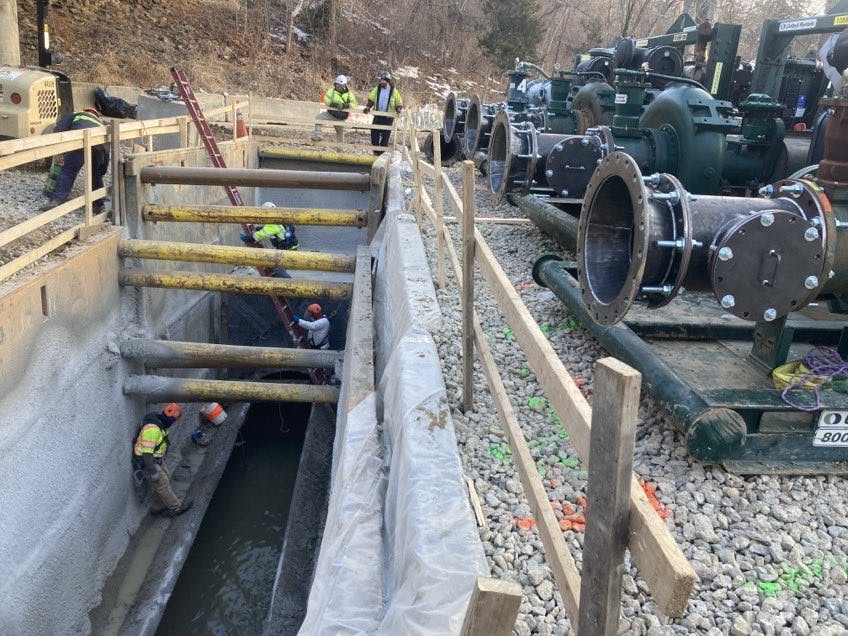
By Feb. 16, two new access pits were constructed to allow for planning and removal of the rock dam blocking the flow through the interceptor. Once that rock is removed further assessment can be made and repairs can then begin.
Potomac Interceptor collapse and overflow: A timeline
- January 19, 2026 - Security cameras discovered overflow and investigate collapse.
- January 20, 2026 - DC Water developed bypass plan to contain overflow.
- January 22, 2026 - Bypass pumps arrived on site to begin construction of bypass plan.
- January 24, 2026 - Bypass pumps are activated opening door to assessments and eventual repairs.
- January 25, 2026 - DC Water shares it neared full containment of the sanitary sewer overflow.
- January 29, 2026 - DC Water announces no overflows were detected for the first time since January 19.
- January 30, 2026 - Excavation continued, soil was stabilized and cleaning of pipe began.
- February 5, 2026 - CCTV inspection reveals a large rock dam 30 feet downstream of the original collapse.
- February 6, 2026 - DC Water released findings of environmental impacts from the sewer collapse.
- February 9, 2026 - DC Water shared a "significant overflow" of "several hundred thousand gallons of wastewater" of wastewater entered the Potomac River during maintenance of the bypass pumps on Feb. 8. It also noted it is preparing an Environmental Restoration Plan.
- February 10, 2026 - DC Water shared a "limited overflow" of 5,000 gallons was contained Feb. 9, and none of the water entered the Potomac River.
- February 11, 2026 - DC Water CEO David L. Gadis published open letter to the public.
- February 14, 2026 - Crews completed construction of two new access pits to begin restoration work.
- February 16, 2026 - DC Water neared completion of advanced bypass system. President Trump calls for federal oversight of the Potomac Interceptor collapse response.
About the Author
 Bob Crossen
Bob Crossen
Bob Crossen is the vice president of content strategy for the Water and Energy Groups of Endeavor Business Media, a division of EndeavorB2B. EB2B publishes WaterWorld, Wastewater Digest and Stormwater Solutions in its water portfolio and publishes Oil & Gas Journal, Offshore Magazine, T&D World, EnergyTech and Microgrid Knowledge in its energy portfolio. Crossen graduated from Illinois State University in Dec. 2011 with a Bachelor of Arts in German and a Bachelor of Arts in Journalism. He worked for Campbell Publications, a weekly newspaper company in rural Illinois outside St. Louis for four years as a reporter and regional editor. Crossen can be reached at [email protected].