What is trickling filter wastewater treatment?
Key Highlights
- According to the EPA, a trickling filter is an aerobic treatment system that uses microorganisms attached to the filter media to remove organic matter from wastewater.
- Trickling filters can reduce the concentration of biochemical oxygen demand over five days (BOD5), total suspended solids including soluble organic matter, total nitrogen and phosphorus, and chemical oxygen demand (COD).
- Polyethylene and thermoplastics have been used as media in trickling filter systems.
- State regulations govern the type of media for tricking filters.
- Due to the accumulation of microorganisms on the solid medium into a biofilm, sloughing of the thick biofilm can occur leading to clog in the system and consequential weakened performance.
- Although both trickling filters and activated sludge utilize the actions of microorganisms to break down wastewater chemicals including organic matter, they are also relatively different in where the microorganisms are found and how oxygen is supplied.

With a capacity to treat 1,088 mega-liter of wastewater per day and expanded in 2025, the large white, dome structures – home to trickling filter wastewater treatment – of the Annacis Island Wastewater Treatment Plant in British Columbia, Canada could be seen from the Alex Fraser Bridge. However there was an unusual sight from this bridge on the morning of December 9, 2024 – the dome roof structure, weighing 75,000 pounds, was lifted by a crane, and then set on the ground.
Inside the domes are plastic grids that are sprayed with the influent wastewater using a rotating distributor. The dome had to come off first to replace the 29,000 plastic grids after 30 years of use.
Although winds of more than 5.5 miles per hour could wobble the lifted roof, this high stakes operation went well while the trickling filter stayed off line due to the resilience of metro Vancouver’s wastewater system. Due to its simple design and efficient operations, trickling filters in wastewater treatment facilities can rapidly reduce the concentration of biochemical oxygen demand over five days (BOD5), total suspended solids including soluble organic matter, total nitrogen and phosphorus, and chemical oxygen demand (COD).
Technical advancement and economic advantages also factor into upgrading existing trickling filter facilities. For example, the Vallejo Flood & Wastewater District, California upgraded their aging infrastructure including the trickling filter media in 2024. For wastewater operators to be better informed about how to maintain the efficiency of this historically prominent technology, it is imperative to understand how trickling filter treatment works and how it compares to wastewater treatment using activated sludge.
Definition of trickling filter for wastewater treatment
Mentioned as a low-cost technology in Title 40, Chapter I, § 35.2030 (a) (1), trickling filters are defined by the EPA as “an aerobic treatment system that utilizes microorganisms attached to a medium to remove organic matter from wastewater.” Originating from the wastewater, the microorganisms adhere on the filter medium, an integral component of the trickling filter system.
Did you know?
Crushed rocks were used as trickling filter medium in the 1940s. Modern innovations for trickling filter media include the thermoplastic acrylonitrile butadiene styrene.
How does a trickling filter work?
Also known as fixed-film wastewater treatment, trickling filters for wastewater treatment are aerobic systems that require aeration and are housed in cylindrical shaped structures where wastewater effluent enters from an inlet pipe at the bottom. Flowing upward the inlet pipe, the effluent is mixed with air and is sprayed through a rotating arm sprayer onto a permeable filter medium containing immobilized layers of microorganisms.
The total suspended solids including organic matter, nitrogen, and phosphorus from the wastewater are treated specifically via a process called microbial metabolism by the microorganisms while clean water trickles through the permeable medium. It is collected in an outlet area at the bottom of the structure and is drained from the outlet pipe.
Within this cylindrical shaped structure are ventilation ports located towards the bottom that allows air to enter. The air mixes with the wastewater to aerate the wastewater, an important factor because the process for the microbial metabolism of chemicals including organic matter in wastewater requires oxygen – in other words, it is an aerobic process.
What media is used in trickling filters?
According to the EPA fact sheet on trickling filters, the medium could be rock, slag, or plastic. Studies have shown the effectiveness of plastics including polyethylene in trickling filter wastewater treatment.
Using polyethylene mesh as the filter material, 84% of total suspended solids, 92% ammonium nitrogen, and 61% COD was removed from the wastewater. Shredded acrylonitrile butadiene styrene, a thermoplastic of high mechanical strength, and chemical inertness, has also shown ability as a media filter packing to remove 94% BOD5, 78% COD, and 93% total suspended solids in wastewater originating from a septic tank.
State regulations
The type of media for tricking filters are governed by state regulations. For example, Texas regulations, 30 Tex. Admin. Code § 217.182, covers both rock and synthetic filter media used in trickling filters for wastewater treatment.
This regulation covers prohibited and permitted size along with grade of the rock filter media. In this regulation, a synthetic media, besides being insoluble in water, must be resistant to flaking, UV degradation and disintegration.
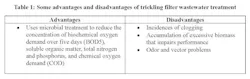
What are the advantages and disadvantages of trickling filters?
Using microorganisms to reduce the concentration of BOD5, soluble organic matter, total nitrogen, phosphorus, and COD is the basic advantage of trickling filter wastewater treatment. However as Table 1 mentions, the sloughing of the thick microbial layer, known as the biofilm, can clog the system and consequentially weaken the performance of the trickling filter unit.
Sloughing issues are indirectly addressed in state regulations. For example, Wisconsin regulations on trickling filters in NR 110.19 contains guidelines on hydraulic loading that determines the type of filter to use. Because wastewater contains chemicals that are nutrients for microorganisms and faster biofilm growth can occur in higher hydraulic loading, these guidelines on hydraulic loading are integral for controlling the rate of biofilm development.
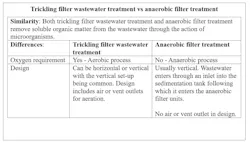
How does trickling filter compare to activated sludge?
Although both trickling filters and activated sludge utilize the actions of microorganisms to break down wastewater chemicals including organic matter, they are also relatively different in where the microorganisms are found. While the microorganisms are immobilized on the filter medium in trickling filters, they are suspended in the mixed liquid in activated sludge.
The process of how oxygen is supplied also differs for these two processes. While oxygen is supplied by the upward movement of the effluent in vertical trickling filter systems and also through the aeration valve, it is supplied by mechanical or diffused air aeration in the activated sludge process.
Wisconsin regulations on trickling filters, NR 110.19, requires that new trickling filters “shall” be used in conjunction with other treatment units which in combination will produce an acceptable level of treatment further defined in the regulations. Additionally, there are also state regulations such as in Texas, 30 Tex. Admin. Code § 217.182, that requires upstream preliminary pretreatment units for trickling filters to remove grit and to control the release of hydrogen sulfide, a gas associated with odor at tricking filter facilities.
The use of trickling filters in conjunction with other treatments and after preliminary treatments could be challenging due to the need to optimize numerical parameters. Can artificial intelligence pave the way to optimize these numerical parameters?
About the Author
 Saleha Kuzniewski
Saleha Kuzniewski
Saleha Kuzniewski, Ph.D. has authored several publications in the fields of scientific research, biotechnology, and environmental regulations. She is the winner of the 2023 Apex award for publication excellence. She is also the founder of Environmental Remediation & Innovations, LLC. Kuzniewski can be reached at [email protected].