What is biosolids management?
Key Highlights
- The term biosolid is used interchangeably at the general, state, and federal levels with treated sludge, municipal sewage sludge, and sewage sludge.
- Biosolids are produced in the primary, secondary, and tertiary wastewater treatment process with less biosolid formation in the secondary treatment compared to the primary treatment.
- The chemical composition of biosolids vary depending on the origin of the influent and the treatment processes in the wastewater treatment plant.
- Besides nutrient and organic matter, biosolids could also contain heavy metals and pathogens.
- The Clean water Act, specifically Title 40, Chapter I, Subchapter O, Part 503 regulates the treatment, disposal, and management of biosolids.
- Based on the concentration of pathogens as per the pathogen treatment method as in CFR Part 503, subpart D on pathogens and vector attraction reduction, biosolids can be classified as Class A, B, or A-EQ.
- State laws for biosolids management includes the State of Washington law, Chapter 70A.226 RCW that includes federal requirement, transportation, beneficial uses, and enforcement.
- Biosolids, after treatment and compliance with state and federal regulations have beneficial reuse to support crop growth, silviculture, and for supporting the bioremediation process to remove high levels of lead in soil.
In a wastewater treatment plant, the influent water is treated, resulting in its separation into liquid and solids. The solids undergo physical and chemical treatments to produce semi-solids, also known as biosolids.
This odorous, nutrient rich product is federally regulated, as is also at state level at some states, including for how and where it can be used after further treatment because it contains toxic pollutants. This regulation is known as biosolids management. What are biosolids and what are these regulations?
What are biosolids?
The term “biosolid” is used interchangeably at the general, state, and federal levels. In general, the term “biosolid” has been referred to as treated sludge and treated sewage sludge. When applied as fertilizers and originating from wastewater treatment, it is referred to as municipal biosolids.
State definition
The New York State Department of Environmental Conservation uses the terms “biosolid” interchangeably with “sewage sludge” as also EPA that described biosolids as sewage sludge that has been treated to meet federal regulatory requirements prior to the intended land use.
The term is also used interchangeably in Washington State with municipal sewage sludge. In RCW 70A.226.010 (1) (quote): “biosolids” means municipal sewage sludge that is primarily organic, semisolid product resulting from the wastewater treatment process, that can be beneficially recycled and meets all requirements under this chapter.”
Federal definition
While no federal definition is provided for biosolids, there is a federal definition for sewage sludge in 40 CFR § 501.2, which is: “solid, semi-solid, or liquid residue removed during the treatment of municipal waste water or domestic sewage. Sewage sludge includes, but is not limited to, solids removed during primary, secondary or advanced waste water treatment, scum, septage, portable toilet pumpings, Type III Marine Sanitation device pumpings (33 CFR part 159), and sewage sludge products. Sewage sludge does not include grit, screenings, or ash generated during the incineration of sewage sludge.”
How are biosolids produced in a wastewater treatment plant?
The first treatment in a wastewater treatment plant is generally the grit and screening process for removing coarse materials that could cause clogging and abrasion of the equipment. It is in the following processes – the primary, secondary, and the tertiary treatment – where biosolids are produced.
In the primary treatment that uses the gravity sedimentation process, suspended particles settle down (sedimentation) in the tank due to gravity, as the process name implies. The solids’ concentration in the biosolids here is 3% to 7%.
In the secondary treatment, microorganisms are used to degrade organic carbon and other suspended particles. Because subsequently more solids are removed here following primary treatment, the solids’ concentration in the biosolids is also lower than in primary treatment – 0.5% to 2% only.
Both the secondary and tertiary treatment are common in publicly owned treatment works that require compliance with the Clean Water Act. Tertiary treatment involves chemical precipitation and other methods to remove nitrogen and phosphorus before the effluent can be discharged. The precipitation is done using lime and polymers although iron and aluminum salts have also been reportedly used. While the use of lime results in the formation of alkaline biosolids, the use of iron and aluminum salts result in the formation of water-absorbing biosolids.
Chemical composition of biosolids from wastewater treatment
Biosolids are semi-solids that originate from wastewater influent from the primary, secondary, and tertiary treatments. The composition of the biosolids varies depending on the origin of the influent and the treatment processes in the wastewater treatment plant.
Besides nutrients and organic matter, the composition which depends on the secondary and tertiary treatment conditions and methods, they also contain sand and silt. Of concern are heavy metals and other potentially harmful contaminants such as pathogens.
A study showed the presence of opportunistic pathogens and quaternary ammonium compounds including alkyltrimethylammonium compounds in the resulting biosolids in wastewater treatment plants that served between 10,000 to 50,000 people. The influent included wastewater from hospitals and food industry.
Biosolids could also contain trace amount of heavy metals. While low concentrations of chromium, selenium, and zinc are micronutrients for plants, they are toxic for health in higher concentrations and thus, federal compliance and state compliance are required before the biosolids could be used or disposed.
What regulations govern biosolids treatment, disposal, and management?
The Clean Water Act regulates biosolids. Specifically, this Act regulates the treatment including for pathogens, land application, and disposal of sewage sludge which is in Title 40, Chapter I, Subchapter O, Part 503. This federal regulation does not contain the word “biosolid” anywhere.
However and notably, the EPA published a document titled, A Plain English Guide to the EPA Part 503 Biosolids Rule, where they exclusively referenced sewage sludge as biosolids, while explaining CFR Part 503, by including the term “[biosolids]” next to the term “sewage sludge”. Recall earlier in this article that the EPA and the New York State Department of Environmental Conservation use the term “biosolid” interchangeably with “sewage sludge”.
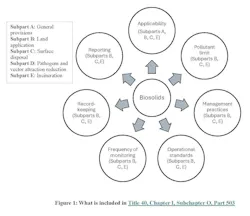
Figure 1 presents a content summary of CFR Part 503. Subpart A is on general provisions while subpart B is on land application. Subpart C is on surface disposal and it also covers pollutant limits other than domestic septage. Subpart D is on pathogens and vector attraction reduction. It also covers classes A and B sewage sludge along with alternative for these classes for pathogen reduction. Subpart E is on incineration that also includes specific risk concentration for chromium.
State biosolids management
There are also state laws for biosolids management in some states. For example, Washington State has a law, Chapter 70A.226 RCW, for municipal sewage sludge that they call biosolids because, as mentioned earlier in this article, biosolids means municipal sewage sludge according to RCW 70A.226.010. This state law also includes biosolid management, specifically transportation of biosolids (RCW.70A.226.020), beneficial uses (RCW.70A.226.040), and enforcement (RCW.70A.226.060). Permits for biosolids management is covered in Chapter 173-308 WAC.
Biosolid classes
Biosolids can be classified as Class A or B based on the pathogen treatment method in CFR Part 503, subpart D on pathogens and vector attraction reduction. Both classes differ in the treatment method for pathogens and the resulting density of the pathogens.
The EPA explains the differences between these two classes and a third class, Class A-EQ. The difference between the three classes is basically the treatment they have undergone as in CFR Part 503.
Class B
Class B biosolids have undergone treatment processes according to CFR Part 503 that significantly reduce but do not eliminate pathogens in treated sewage sludge (biosolid) and thus, there are additional requirements for land application of Class B biosolids.
Class A
Comparatively, Class A biosolids have undergone treatment to further reduce the risk of pathogens as in CFR Part 503, further than for Class B biosolids, in treated sewage sludge (biosolids) and thus, they have fewer additional requirements for land application. Class A biosolids are applied to recreational areas like parks and golf courses.
Class A-EQ
Class A-EQ (Exceptional Quality) biosolids, compared to Classes A and B, meet the most stringent reduction limits in CFR Part 503 for pollutant, pathogens, and vector attraction reduction. They meet the ceiling concentrations in Table 1 of § 503.12, the pollutant concentrations in Table 3 of § 503.13, class A pathogen reduction requirement in § 503.32(a) and one of the vector attraction reduction requirements in § 503.33 (b)(1) through (b)(8). Because Class A-EQ biosolids meets the most stringent limits in CFR Part 503, they don’t have additional requirements for land application and thus, are sold to the public for lawn and garden use.
Can biosolids be used for beneficial reuse?
Yes, biosolids can be used for beneficial reuse including for lan application if they are first treated and meet federal, state, tribal, and local requirements.

Land application
The EPA’s 1994 report on the beneficial use of biosolids included its use as a natural fertilizer and for agriculture due to the presence of organic and inorganic chemicals that function as nutrients. When applied to land, less chemical fertilizer was required for crops than without biosolids.
This report also included the nonagricultural uses of biosolids, namely in silviculture to increase forest productivity, and to stabilize the soil which uses alkaline biosolids. These biosolids have also been used, besides for improved corn productivity, for removing high levels of lead in soil by supporting the remediation process.
Biosolids are unavoidable – they are generated in wastewater treatment plants. With interchangeable terms for biosolids such as municipal sewage sludge and sewage sludge based on the general, state, and federal definitions compounded with the complex regulations for biosolids in CFR Part 503 that includes three different classes of biosolids, the EPA document titled, A Plain English Guide to the EPA Part 503 Biosolids Rule is relevant for wastewater treatment plants to understand how to treat and manage biosolids. Looking into the future, in a world that relies on newer, improved technologies that rely on chemicals, which of course can land in the wastewater influent, biosolids of the future could contain new chemicals of concerns. This makes the EPA guide to Part 503 all the more important for wastewater treatment plants.
About the Author
 Saleha Kuzniewski
Saleha Kuzniewski
Saleha Kuzniewski, Ph.D. has authored several publications in the fields of scientific research, biotechnology, and environmental regulations. She is the winner of the 2023 Apex award for publication excellence. She is also the founder of Environmental Remediation & Innovations, LLC. Kuzniewski can be reached at [email protected].