Designing wastewater treatment plants for climate resilience
Key Highlights
- Wastewater facilities are increasingly impacted by simultaneous hazards like heavy rainfall, rising river levels, and coastal surges, challenging traditional flood protection standards.
- Effective adaptation involves layered protection strategies, including floodproofing critical systems, elevating infrastructure, and hardening electrical and control systems to maintain operational continuity.
- Designing new treatment plants now emphasizes flexibility, staged pumping, onsite storage, and modeling of complex interactions to ensure resilience during prolonged or compound flooding events.
- Operational continuity depends on integrated assessments of rainfall, hydraulics, and downstream conditions, rather than isolated system evaluations, to identify vulnerabilities and failure points.
Wastewater treatment plants have always been designed to operate under changing conditions, including flows, fluctuating loading rates, equipment outages, and operational interruptions. What has changed over the last decade is the frequency and severity of extreme events, along with the way multiple hazards now occur simultaneously.
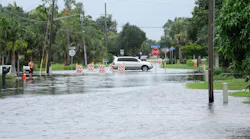
In many regions, intense rainfall is occurring simultaneously with elevated river stages, coastal surge, or tidal influence. These combined conditions can create flooding scenarios that exceed the assumptions built into older design standards and, in some cases, challenge newer infrastructure as well.
For wastewater utilities, the consequences can be immediate. Treatment capacity may be reduced, electrical and control systems can become compromised, operator access may be restricted, and the risk of untreated discharge increases significantly. Climate adaptation is no longer viewed as a long-range planning exercise. It has become a practical engineering and operational requirement centered on maintaining treatment continuity during extreme events and restoring functionality as quickly as possible afterward.
The hazard many plants weren’t designed for: Compound flooding and constrained discharge
One of the most significant shifts in wastewater planning has been the growing recognition that system performance during major storm events is often impacted as much by downstream conditions as by rainfall itself. When river levels, tides, or coastal surges elevate receiving-water conditions, gravity discharge systems can become ineffective or unavailable altogether. Backwater conditions move upstream, hydraulic grade lines rise, and collection and treatment systems begin operating very differently than they do under conventional design-storm assumptions.
Under these conditions, many systems effectively transition from gravity-driven operation to temporary storage and pumping-dependent operation. Tide gates and flap gates close to prevent backflow, reducing the discharge head and allowing surcharging to extend well beyond areas traditionally considered vulnerable to flooding. This interaction between inflow and downstream boundary conditions, commonly referred to as compound flooding, has become increasingly important in vulnerability assessments and facility planning.
An often-overlooked aspect of wastewater flood vulnerability is that the governing failure mechanism is rarely influenced solely by site elevation. In many facilities, the initial operational breakdown occurs before floodwater physically enters critical structures. As downstream water levels rise, hydraulic efficiency decreases, gravity drainage becomes restricted, and portions of the system begin to surcharge internally.
In practice, these conditions can gradually reduce system functionality long before overtopping occurs. Tailwater effects, pumping limitations, internal drainage constraints, and storage availability can all interact in ways that are difficult to identify through isolated analyses.
For that reason, effective adaptation planning requires evaluating the treatment plant as an integrated hydraulic and operational system rather than as a collection of independent assets. In STV’s work with utilities across a variety of environments, we find that the controlling condition is often dynamic and only becomes apparent when rainfall timing, tidal conditions, pump performance, and internal conveyance limitations occur simultaneously.
 65c539e931b736001e3faf31dreamstime_xxl_25437002
Existing facilities: Start with vulnerability and protect what must stay online
Most flood protection investments today are focused on existing wastewater treatment plants, many of which were constructed decades ago on low-lying sites adjacent to rivers, estuaries, or coastal waters. These facilities were typically designed using historical flood records and under the assumption that gravity discharge would remain available during major storm events – assumptions that are becoming increasingly difficult to rely upon.
Effective adaptation programs generally begin by identifying the systems that must remain operational under all conditions. These typically include power distribution equipment, motor control centers, supervisory control and data acquisition (SCADA) systems, communications, disinfection processes, critical pumping systems, and safe operator access routes. From there, vulnerability assessments evaluate how floodwater could enter the site, move through structures, and affect those essential functions.
Experience across multiple facilities has shown that operational continuity is rarely achieved through a single protective measure. More often, successful programs combine perimeter protection, building-level floodproofing, equipment hardening, selective elevation, and operational redundancy to reduce the likelihood that one localized failure will escalate into a plant-wide outage.
At many facilities, the most effective improvements are not necessarily the most visible ones, but the ones that protect systems least tolerant of disruption: electrical distribution, controls, pumping, disinfection, and critical interconnections between process units. A well-conceived flood protection program starts with assessing asset criticality and failure propagation, then layers protection in a way that preserves operability under partial inundation rather than assuming complete water exclusion under all conditions.
In practice, this may involve elevating or relocating sensitive equipment, sealing penetrations, hardening electrical systems, improving backup power redundancy, and compartmentalizing vulnerable areas so that a localized breach does not compromise the entire facility. The strongest programs also recognize that long-term reliability depends not only on initial design performance, but on how systems can be inspected, maintained, and restored after an event. Accessibility, maintainability, and recovery planning, therefore, become part of the engineering problem itself.

Large-scale protection for a regional wastewater facility
The complexity of resilience upgrades becomes especially apparent at large, continuously operating treatment facilities. At one of the nation’s largest regional wastewater plants in the New Jersey, serving approximately 1.5 million residents and treating up to 330 million gallons per day, vulnerability to coastal surge and flooding prompted a broad, multi-year adaptation initiative following Hurricane Sandy.
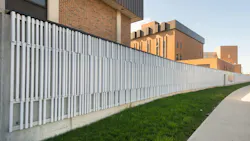
Rather than relying on isolated improvements, the utility implemented a comprehensive protection program anchored by an STV-designed perimeter floodwall surrounding the approximately 140-acre campus. The project also included site drainage improvements, electrical upgrades, and expanded emergency power capability.
A key lesson from the effort was that flood protection for wastewater facilities differs fundamentally from flood protection for conventional buildings. Treatment plants cannot simply shut down during a storm. Influents continue to arrive, biological treatment processes must remain stable, and electrical and control systems must remain functional throughout the event.
Any floodwater entering the treatment process can quickly destabilize operations, affect disinfection performance, and create immediate environmental and regulatory consequences. The project also highlighted the limitations of relying solely on minimum code criteria, particularly in industrial waterfront environments. Standard debris impact assumptions did not adequately account for vehicles, containers, and other heavy objects that could strike protective structures during surge conditions. As a result, site-specific hydraulic modeling and enhanced loading criteria were incorporated to better reflect realistic hazards and future flood scenarios.
Building‑level floodproofing while keeping plants operational
Not all wastewater facilities require or can accommodate full perimeter barriers. In many cases, adaptation efforts focus instead on protecting critical systems within individual buildings while maintaining uninterrupted plant operations.
For example, STV recently worked with a coastal wastewater resource recovery facility in New York that implemented a comprehensive flood protection program for a plant originally constructed in the 1930s. The work included deployable flood barriers, permanent flood walls, flood-resistant doors, sealed penetrations, and selective elevation of electrical and control equipment.
Two priorities drove the program. First, construction activities had to be phased to keep the facility fully operational throughout implementation, a requirement directly tied to public health protection and permit compliance. Second, the project emphasized maintaining safe and reliable operator access during extreme weather conditions, recognizing that treatment reliability depends as much on personnel accessibility as on the protection of physical infrastructure.
Projects like this demonstrate that meaningful risk reduction does not always require large or highly visible infrastructure. Carefully targeted building-level improvements can significantly improve facility reliability while remaining compatible with constrained and fully active sites.
What changes for the new wastewater treatment plant design
Designing new treatment facilities provides an opportunity to incorporate long-term reliability considerations from the outset. Increasingly, this means planning for conditions in which gravity discharge may be restricted or unavailable for extended periods, rather than assuming stable downstream conditions during major storm events.
Future-ready facilities are now being designed with greater consideration for elevated tailwater conditions, prolonged discharge constraints, and the timing relationship between rainfall intensity and downstream water levels.
Key design considerations include elevating and separating critical infrastructure, incorporating staged-pumping redundancy, increasing operational flexibility, and providing sufficient onsite storage to manage inflows during periods of constrained discharge.
Rather than focusing exclusively on peak flow conveyance, many modern approaches place greater emphasis on duration-based performance, specifically, how long a facility can continue operating acceptably under stress and how quickly it can recover between successive events.
Modeling interactions, not isolated systems
As system risks become more complex, utilities are moving beyond traditional single-discipline evaluations. Projects that examine rainfall runoff, sewer hydraulics, and coastal or riverine conditions independently often fail to capture how wastewater systems actually behave during extreme events.
Facilities that evaluate rainfall, tailwater conditions, internal hydraulics, pumping limitations, and operational controls together consistently develop a more reliable understanding of system vulnerability and performance.
The objective is not to predict one exact outcome, but to understand system behavior across a range of plausible conditions, identify sensitive failure points, and prioritize investments accordingly.
Particular attention is often given to outfalls, gates, and hydraulic control structures, since these systems form the interface between the treatment facility and the receiving water body. Under severe conditions, their performance can govern plant-wide behavior and should therefore be evaluated alongside structural, mechanical, and electrical improvements.
Reliability also depends on constructability and operations
Even technically sound flood protection measures can become problematic if they cannot be implemented without disrupting treatment operations. At active wastewater facilities, major upgrades must be carefully phased to maintain permit compliance, operator safety, and process reliability throughout construction.
For both retrofit and new-plant projects, constructability should be treated as a primary design consideration rather than a secondary exercise performed late in the design. Wastewater treatment facilities operate continuously and often have limited shutdown flexibility, leaving little tolerance for disruptive sequencing or extended outages. Flood protection improvements, therefore, need to account for temporary operations, tie-in strategy, maintenance access, emergency response, and long-term operability from the outset.
In practice, the strongest projects are those in which engineering design, construction sequencing, and operational planning are developed together rather than independently. A protection measure that performs well on paper but cannot be safely constructed, maintained, or restored during an emergency is unlikely to perform successfully in the field. STV’s experience delivering resilience upgrades shows that successful projects consistently demonstrate the importance of close coordination among designers, utility staff, and contractors so that engineering decisions align with how facilities actually operate day to day and during emergency conditions.
Across a wide range of wastewater adaptation projects, several common priorities continue to emerge:
- Clearly identify which systems must remain operational under all conditions and protect those systems first.
- Treat downstream boundary conditions as a primary design driver rather than a secondary consideration.
- Use layered protection strategies instead of relying on a single line of defense.
- Account for realistic debris hazards and site-specific risks, particularly at industrial and waterfront facilities.
- Design improvements that can be constructed, operated, and maintained within fully active treatment plants.
As climate-driven risks continue to evolve, wastewater utilities are being forced to reconsider longstanding assumptions about system performance and facility design. Increasingly, reliable wastewater treatment depends not only on hydraulic capacity but on adaptability, operational continuity, and the ability of interconnected systems to continue functioning under conditions well beyond those traditionally considered during design.
About the Author
Siavash Hoomehr
Siavash Hoomehr, PE has 20 years of experience in technical delivery and program and project management. He has served as client service manager, principal in charge, senior project manager and senior engineer for many national and local stormwater management, civil design, flood resilience, flood control and flood mapping projects. He brings years of experience with integrated coastal, riverine and stormwater management and flood resilience; floodplain mapping (FEMA); advanced H&H modeling (unsteady and steady, 1D/2D) (USACE & FEMA); dam break analysis, inundation mapping & Emergency Action Plan (EAP); levee superiority/planned overtopping; interior drainage design and scour analysis and countermeasures design. He is currently STV’s water resources director for the east region.