WEFTEC panel urges responsible, practical approach to AI in water sector
Key Highlights
- Utilities should prioritize data quality, staff engagement, and organizational readiness before implementing AI solutions.
- AI applications in water utilities should initially focus on low-risk tasks like workflow management and decision support to complement human expertise.
- Developing clear governance and data management policies is essential to protect sensitive information and guide staff use of AI tools.
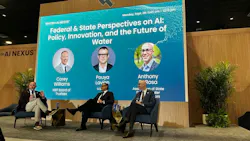
Water utilities should pursue practical applications of artificial intelligence while maintaining human expertise, improving data quality and developing organization-specific safeguards, speakers said during a WEFTEC 2026 session on federal and state perspectives on AI.
The session, “Federal & state perspectives on AI: Policy, innovation and the future of water,” featured Pouya Lavian, deputy chief of staff for policy at the U.S. Environmental Protection Agency, and Anthony DeRosa, executive director of the Association of State Drinking Water Agencies. Corey Williams of WEF moderated the discussion.
DeRosa said utilities face a significant challenge in adopting AI because many existing data systems are outdated, disconnected and affected by data-quality issues. He said utilities should establish a baseline of their technology and data systems before adding advanced AI applications.
“It's people, processes, and technology in that order, always,” DeRosa said. He recommended that utilities first establish staff buy-in, strengthen existing processes and then introduce technology.
Lavian said federal policy should support innovation rather than immediately impose prescriptive requirements as AI applications continue to develop. He encouraged utilities and municipalities to experiment with use cases and share successful approaches so they can inform future policy.
For utilities beginning to use AI, Lavian pointed to lower-risk applications such as workflow management, decision trees and repetitive processes. He said AI should help staff focus on tasks requiring greater judgment and expertise rather than being viewed primarily as a means of eliminating jobs.
Both speakers emphasized maintaining human expertise in AI-supported decision-making. DeRosa described AI as an “instrument” rather than simply a tool and said organizations need experts who can evaluate AI outputs and guide decisions.
“It's ensuring that expertise, human expertise, is driving all of the decision making,” DeRosa said.
The panel also addressed the need for utilities to establish AI governance and data-management policies. DeRosa recommended identifying which information is public, which requires greater protection and which should not be entered into AI systems. He also urged utilities to develop policies governing staff use of publicly available AI platforms.
The discussion included concerns about AI-generated engineering reports and the potential for AI to increase the volume of public-record requests seeking water and wastewater system information. Lavian said utilities should remain discerning when selecting AI vendors and verify claims about technology and its applications.
Rather than waiting for state or federal governments to establish comprehensive AI requirements, Lavian encouraged utilities to develop responsible practices based on their individual circumstances and communicate those experiences to regulators.
DeRosa similarly encouraged utilities to work through professional associations and peer networks to share AI applications, challenges and lessons learned.
The speakers identified cybersecurity as one area where greater collaboration between the water sector, government and private industry is needed. DeRosa called for high-level exploration of how AI can be used to protect critical infrastructure, rather than focusing only on cybersecurity claims made by individual vendors.
Lavian said utilities should first understand their existing technology environment before determining how quickly to adopt AI.
“Everyone wants you to get there fast, but you got to get there responsibly,” Lavian said.
About the Author
 Mandy Crispin
Mandy Crispin
Mandy Crispin is the editor-in-chief of WaterWorld, having joined Endeavor Business Media in 2023. She lives in Las Vegas, Nevada and is a graduate of University of Nevada, Las Vegas. She has internal and external corporate communications experience in disparate industries including online retail, gaming, plastics and is now enjoying exploring the water utility space. Crispin can be reach at [email protected].
 Alex Cossin
Alex Cossin
Associate Editor
Alex Cossin is lead reporter, staff writer and content strategist for Waterworld Magazine, Wastewater Digest, Stormwater Solutions and Water Technology. Cossin graduated from Kent State University in 2018 with a Bachelor of Science in Journalism. Cossin can be reached at [email protected].