Utility leaders discuss practical AI applications at WEFTEC
Key Highlights
- Water utilities view AI as a tool to support employees rather than replace jobs, promoting collaboration and skill development.
- Involving staff from various departments in AI initiatives helps identify valuable applications and increases familiarity with the technology.
- Operational data analysis, especially in wastewater treatment, is a promising area for AI to identify trends and improve efficiency.
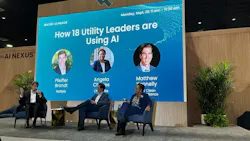
Water utility leaders are approaching artificial intelligence as a tool to augment employees and improve operations rather than replace jobs, according to a WEFTEC 2026 panel featuring Charlotte Water Director Angela Charles and LOTT Clean Water Alliance Executive Director Matthew Kennelly.
The session, “How 18 utilities are using AI,” was moderated by Peiffer Brandt, CEO of Raftelis Financial Consultants, and Kennelly. Brandt said Raftelis’ research with utility leaders has grown into a cohort of about 25 utility general managers and a separate group of utility AI innovators that meet regularly to share experiences and approaches to the technology.
Charles said Charlotte Water, which serves more than 1.3 million people and operates water, wastewater and stormwater services, is taking a broad approach to AI adoption. The utility created an employee AI innovation team that includes staff from operations, engineering, customer service and other areas rather than having its IT department lead the initiative.
Charles said involving employees directly is intended to help the utility identify where AI can provide value while increasing staff familiarity with the technology. The team has examined potential applications including using AI for laboratory chain-of-custody forms.
At LOTT, a 100-employee regional wastewater utility serving about 200,000 people, Kennelly said the organization has established a basic AI policy and is allowing employees to learn how the technology can be applied. He described operational applications as particularly promising because utilities already collect large amounts of data but need better ways to analyze it and identify trends.
The panel also highlighted the importance of maintaining employee expertise as AI adoption grows. Charles described an example in which Charlotte Water engineers developed an algorithm to project water use from a basin. She asked the engineers to run the same inputs through AI as a way to validate their work. The AI and engineering results were similar for the nearer years while the engineers produced more conservative projections for later years.
Kennelly said employees need hands-on experience with AI to recognize when its output is inaccurate. He said utilities will need continued training on how to prompt AI, how to use the technology and what information should be disclosed.
Operational applications emerged as a particular area of interest. Kennelly pointed to wastewater treatment as a potential use case because influent and biological processes are continually changing, creating opportunities for AI to identify trends in operational data. Charles said AI also could have applications in customer service, financial management and system modeling, including potentially taking a customer issue through to the creation of a work order.
Both leaders emphasized peer learning as utilities navigate adoption. Charles said water utilities need to continue discussing AI because the technology is advancing rapidly, while Kennelly said benchmarking with other utilities helped LOTT understand its position and develop an approach suited to its organization.
Charles' advice to utility leaders was to embrace AI and determine how it can be used effectively. Kennelly similarly encouraged leaders to learn the technology themselves before determining how their utilities should deploy it.
About the Author
 Mandy Crispin
Mandy Crispin
Mandy Crispin is the editor-in-chief of WaterWorld, having joined Endeavor Business Media in 2023. She lives in Las Vegas, Nevada and is a graduate of University of Nevada, Las Vegas. She has internal and external corporate communications experience in disparate industries including online retail, gaming, plastics and is now enjoying exploring the water utility space. Crispin can be reach at [email protected].
 Alex Cossin
Alex Cossin
Associate Editor
Alex Cossin is lead reporter, staff writer and content strategist for Waterworld Magazine, Wastewater Digest, Stormwater Solutions and Water Technology. Cossin graduated from Kent State University in 2018 with a Bachelor of Science in Journalism. Cossin can be reached at [email protected].