Why trenchless rehabilitation is graining ground
Key Highlights
- Approximately 45 million cubic meters of water are lost daily due to pipeline leaks in developing countries, highlighting the need for efficient repair solutions.
- Trenchless rehabilitation methods can save 30% to 60% of project costs by eliminating excavation, landscaping, and surface restoration expenses associated with traditional methods.
- Cured-in-Place Pipe (CIPP) is the most widely used trenchless technology, capable of restoring pipelines with minimal disruption and installation rates five times faster than conventional replacements.
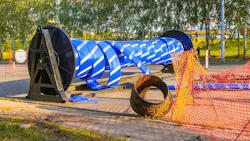
In developing countries, about 45 million cubic meters of water is lost daily through leakage in the distribution networks – enough to serve roughly 200 million people – according to World Bank.
At a time when over 2.2 billion people worldwide still lack access to safe drinking water, these leaks continue to waste a vital resource. Bridging this gap and ensuring water reaches those who need it most requires one fundamental solution: repairing the pipelines underground – or, where necessary, replacing them altogether.
Utilities face a critical challenge: how to repair/replace deteriorating assets without tearing up roads, disrupting communities, and escalating project costs. To address this, many are rapidly adopting trenchless rehabilitation methods, which can renew underground infrastructure with minimal surface disturbance.
Why trenchless methods?
Aging underground water pipelines is a growing global challenge. Much of the water infrastructure installed across the world, is now approaching the end of its service life.
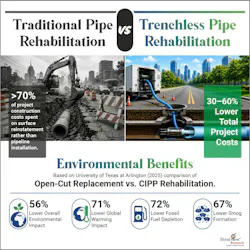
The challenge extends beyond replacing deteriorated pipes. For municipalities and utilities, the real burden often lies in the disruption and restoration work associated with conventional open-cut replacement. Industry sources indicate that with open-cut pipeline replacement, over 70% of a project’s construction costs will be spent for reinstatement of surface only, not installation of the pipeline.
Trenchless pipe rehabilitation methods are proven to save 30% to 60% in total project costs compared to traditional dig-and-replace methods. While the base cost of materials can be similar, the massive savings come from eliminating excavation, landscaping, and hardscape repairs.
The study from the University of Texas at Arlington (2025) comparing open-cut replacement with the widely used trenchless method – Cured-in-Place Pipe (CIPP) rehabilitation found:
- 56% lower overall environmental impact
- 71% lower global warming impact
- 72% lower fossil fuel depletion
- 67% lower smog formation
Equally important, many trenchless rehabilitation solutions can extend pipeline service life by more than three decades, providing utilities with a cost-effective and sustainable pathway to modernize aging infrastructure.
Commercial significance of the top trenchless techniques
Trenchless, or say minimally invasive technologies that specifically restore and strengthen existing pipeline systems without the extensive disruption, environmental impact, or financial burden typically associated with traditional open-cut excavation methods.
Developed back in 1940s, Slip Lining is said to be the oldest trenchless repair methods, that was most suitable for networks without a lot of bends. The process involves pulling or pushing a new, smaller-diameter pipe directly inside the damaged, older pipe. The resulting gap between the two pipes is then filled with grout. While this is highly cost-effective and structurally sound, it does slightly reduce the internal diameter and flow capacity of the pipeline. Over the years, other no-dig technologies like Cured-In-Place Pipe (CIPP) lining and pipe bursting, etc. were developed to overcome this capacity loss.
Today, nearly 4 out of every 10 trenchless rehabilitation projects are carried out using CIPP, making it the most widely adopted trenchless rehabilitation method globally. Its popularity stems from its ability to restore aging pipelines without full pipe replacement. The method is particularly effective in pipelines with bends and difficult-to-access sections, as the flexible liner can be inserted through the existing pipe and cured in place to form a new structural lining. CIPP has found extensive use in wastewater main pipelines, where installation can be completed at rates approximately five times faster than conventional pipe replacement. According to Stratview Research, by 2030, annual spending on CIPP rehabilitation projects is expected to approach US$3.5 billion worldwide.
However, the only trenchless pipe rehabilitation method that replaces the entire pipe instead of repairing it is – Pipe Bursting. This method is rapidly being adopted across the globe, after CIPP. Suitable for non-pressure applications, this method is employed mostly when the required pipe diameter is higher than the original or if the cracks are beyond repair. This technology minimises the chances of developing stoppages as an entire pipe bursts and a new pipe is placed.
Meanwhile, other technologies such as Spiral Wound Lining and Spray-In-Place Pipe (SIPP) are efficient, jointless, seamless, and long-lasting solutions for ageing underground pipelines. By providing enhanced adaptability, these are suitable for non-standard pipe geometries, irregular defects, or applications where traditional access points are limited.
Why regions are turning to trenchless rehabilitation?
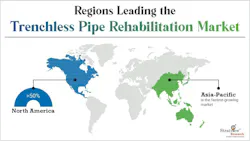
More than half of all trenchless pipe rehabilitation projects worldwide take place in North America (NA), where utilities are grappling with vast pipeline networks that have been in service for decades. Drinking water infrastructure in the U.S. alone comprises over 2 million miles of underground transmission and distribution lines. Some of the nation’s oldest pipes were laid in the 19th century, and pipes laid post–World War II have an average lifespan of 75 to 100 years, meaning that many of even the newer pipe segments are reaching or have reached the end of their design life.
As utilities face mounting pressure to address leaks, pipe failures, and service disruptions without excavating densely populated urban areas, trenchless rehabilitation has emerged as the preferred alternative to conventional replacement. The result is a mature market characterized by continuous rehabilitation spending rather than new network construction. The nation is about to invest billions for rehabilitation. The scale of NA's aging pipeline network is expected to translate into a trenchless pipe rehabilitation market worth over $5.5 billion by 2032, according to Stratview Research.
Europe follows as the second-largest trenchless rehabilitation market. The region's advantage stems from its exceptionally old underground infrastructure, with many water and sewer networks dating back to the late 19th and early 20th centuries, and some city systems operating on infrastructure more than 100 years old.
In contrast, Asia-Pacific (APAC) is the fastest-growing market. Unlike NA and Europe, where the focus is primarily on rehabilitating aging networks, many Asia-Pacific countries are simultaneously expanding and modernizing their water infrastructure. The region is home to more than half of the world's population, and the Asian Development Bank estimates that APAC will require roughly $4 trillion in water, sanitation, and hygiene investments by 2040. Rapid urbanization, growing municipal networks, and increasing investments in countries such as China and Japan are accelerating the adoption of trenchless technologies.
The next chapter in water infrastructure renewal
The challenge facing global water infrastructure is no longer a question of whether rehabilitation is needed, but how quickly it can be delivered. The World Economic Forum estimates a €6.5 trillion global water infrastructure investment gap by 2040, highlighting the scale of upgrades required to maintain reliable water services for a growing population.
Trenchless technologies are proving their value here. Take the 140-year-old Pequannock Aqueduct system of Newark's (New Jersey) rehabilitation case of 2025, for instance. It demonstrates how trenchless technology was precisely used to repair structural defects within historic pipelines, and the city was able to preserve vital infrastructure without major excavation. This project was completed within 4 days. The selection of advanced fiber-reinforced polymer (FRP) lining systems further reflects the industry's growing focus on durability and sustainability – the same systems that was recognized as the world’s first green and sustainable pipe in 2016 by the American Society of Civil Engineers (ASCE).
As governments and utilities continue investing in aging water networks, demand for trenchless rehabilitation is expected to accelerate. The combination of aging infrastructure, water-loss reduction initiatives, sustainability targets, and advances in lining materials positions the industry for sustained long-term growth.
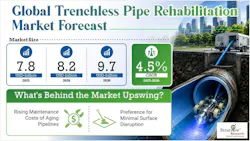
Stratview Research estimates that spending on trenchless pipe rehabilitation will surpass $9.6 billion by 2032 – adding more than $2 billion in annual market value compared with 2025 levels. For utilities worldwide, trenchless rehabilitation is increasingly becoming not just the most efficient option, but often the most logical one.
About the Author
Chandana Patnaik
Chandana is a Senior Content Strategist at Stratview Research, with over 8 years of experience in content strategy, industry research, and editorial writing. She specialises in developing research-backed content covering market trends, emerging technologies, and industry developments across sectors.