Advantages Of Resilient Hinge Check Valves Over Traditional Swing Check Valves
Key Highlights
- There are pros and cons to both resilient hinge check valves and traditional swing check valves.
- Resilient hinge check valves offer a simple, maintenance-free design, with only one moving component.
- Resilient hinge check valves provide an anti-clog solution for pipelines containing raw sewage and heavy solids.
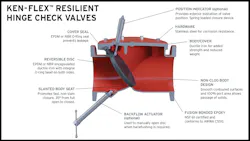
- MPI’s KEN-FLEX resilient hinge check valve features a reversible disc that can double its lifespan.

The modern swing check valve design, patented in 1960, featured a metal hinged disc that swung completely out of the flow path, along with a bolted bonnet that allowed the valve to be serviced without removing it from the pipeline. Today’s design has not changed dramatically from the original, aside from the disc being reshaped to help with clogging issues and closure devices being added to prevent slamming, which in turn prevents water hammer.
The swing check valve remained the standard for the water and wastewater industry for decades, until the resilient hinge check valve was first introduced to the market in 1965. This was a revolutionary design, considering it eliminated all internal components of the standard swing check and replaced them with a single piece – a metal disc, fully encapsulated in rubber.
This original design has been refined several times to give us the modern resilient hinge check valve we use today. One recent innovation was MPI’s introduction of the KEN-FLEX™ symmetrical resilient hinge design, allowing the disc to be flipped when worn or damaged, providing a fresh sealing surface and doubling disc lifespan.
RESILIENT HINGE VS. SWING CHECK
The modern resilient hinge check valve has been rapidly replacing the standard swing check valve due to several factors.
Simplicity
A resilient hinge check valve only has one moving component. This dramatically reduces the risk of premature component wear due to disc oscillation in low-flow situations. A swing check valve has several components that are prone to premature wear if the flow guidelines for a swing check valve are not adhered to.
Fast Closing
A resilient hinge check valve has a very short travel of 27 to 35 degrees compared to a standard swing check’s disc travel of 75 to 90 degrees. The shorter travel naturally prevents slamming because the disc takes much less time to swing shut when the flow reverses.
Long Lifespan
The KEN-FLEX style resilient hinge is reversible. This allows both a quick fix if the seat is damaged by sharp debris and the long-term benefit of doubling the lifespan of the original valve. It is true that the seat ring on a swing check valve can be replaced without fully rebuilding the disc and hinge mechanism. However, when the disc ring wears out through normal operation, several other internal components typically require replacement as well. Either case requires the swing check valve to be completely disassembled.
No External Components
A resilient hinge check valve is completely maintenance free with no external packing glands like a swing check valve. Packing glands require routine tensioning and rebuilding to prevent leaks around the shaft.
Anti-Clog Design
While both the swing check valve and resilient hinge check valve have a full port design, the resilient hinge check valve body was specifically designed to provide a smooth flowing, anti-clog solution for pipelines containing raw sewage, heavy solids, and fibrous material.
The disc of the traditional swing check valve has been redesigned in recent years to have a domed shape which does help prevent matting or ragging on the disc. However, the larger body cavity creates a zone of lower fluid velocity and turbulence. In wastewater or sludge applications, solids drop out of suspension in these low-flow pockets, causing heavy sediment build-up.
The hinge mechanism(s) and hardware that hang in the flow path are undesirable for applications with solids present. Even with a modern disc that is domed to shed debris, these sharp edges and narrow joints act as an internal anchor. Rags, hair, and stringy materials catch on those points and gradually gather more debris over time.
AN ADVANTAGE OF BOTH DESIGNS: SPRING ASSISTED CLOSURE
In applications where it is critical that the check valve closes before any backflow occurs, such as installing a check valve immediately downstream of a turbine pump, a spring assisted closure device is routinely the recommended solution. Both the swing check and the resilient hinge valves have spring assist options.
A swing check valve can be equipped with a lever & spring closure device to rapidly close the disc before any backflow occurs. A resilient hinge check valve can also be equipped with a spring assisted disc. This is either a stand-alone spring attached to the backside of the disc or a spring with a cover protecting it from collecting media. An example of a fully protected spring closure device is an MPI spring-loaded position indicator.
Note: Some manufacturers utilize a leaf spring design that only pushes the disc partway closed. The most effective way to prevent slamming is with a spring that pushes the disc all the way to the closed position.
IN SOME INSTANCES, THE SWING CHECK VALVE HAS THE ADVANTAGE:
Slow Closing
Some applications, such as longer pipelines, require that a check valve close slowly to prevent slam, rather than closing as quickly as possible. In these applications, a swing check valve with an oil control closure device is the best method to accurately control the closing of the disc.
Lay Lengths
The original design of the resilient hinge check valve did not follow AWWA guidelines for lay lengths. This led to several manufacturers producing resilient hinge designs with the same non-standard lay lengths. Fortunately, MPI is now taking steps to standardize the lay lengths of our KEN-FLEX resilient hinge check valves. This will enable the direct replacement of swing check valves with resilient hinge check valves where an application has been problematic for a standard swing check.
SUMMARY
In many applications, the resilient hinge check valve is a better choice, either for its non-clogging design, its fast-closing speed, or its low maintenance costs. The resilient hinge check valve has proven itself with decades of successful use in the municipal water industry and should be considered first before choosing a traditional swing check valve.