PFAS in biosolids: Expanding regulation and growing litigation in 2026
Key Highlights
- PFAS chemicals are increasingly detected in biosolids, prompting regulatory scrutiny and public concern over soil and groundwater contamination.
- States are adopting diverse policies, with some banning land application of PFAS-contaminated biosolids, leading to operational and legal challenges for waste management companies.
- Recent lawsuits target not only wastewater dischargers but also entities involved in biosolids processing and marketing, emphasizing the importance of legal preparedness.

Mounting public attention to biosolids as a potential route for contamination of soil and groundwater by per- and polyfluoroalkyl substances (PFAS) — so-called “forever chemicals” — is causing a rapid shift in the legal landscape.
In the absence of federal action, state and local governments are moving ahead with diverse policies that impose different standards and requirements regarding biosolids. These differences may complicate compliance and impact corporate wastewater management practices.
Further, lawsuits related to PFAS in biosolids have been increasing. Businesses that are alleged to have discharged wastewater containing PFAS have historically been the focus of litigation. More recent lawsuits, however, have also centered on allegations against entities operating wastewater treatment plants and companies producing, applying, or selling biosolids and biosolid-derived fertilizers.
Tracking existing and proposed rules enables companies to proactively address compliance challenges and avoid unnecessary litigation. Companies should work with experienced counsel to help them ensure compliance and better position them to address potential government action or private litigation.
Current landscape of biosolids and their disposal methods
Wastewater treatment plants produce sewage sludge by separating solid materials from wastewater before discharging the liquid effluent. Sewage sludge is typically nutrient-rich and can be converted into biosolids that serve as sustainable, low-cost alternatives to artificial fertilizers.
The most recent data shows that roughly 55% of all sewage sludge in the United States is processed into biosolids and land-spread as fertilizer or soil conditioner, with the majority applied to agricultural land.1 Virtually all the remainder is disposed of by landfilling (27%) or incineration (16%).2 The U.S. Environmental Protection Agency regulates use and disposal of sewage sludge under the Clean Water Act, regardless of method.3


For sewage sludge to qualify as a biosolid eligible for land application, it must meet EPA standards for maximum levels of certain metals and pathogens and be processed to reduce odor and attractiveness to disease vectors (e.g., insects). Although the EPA considers potential additions to the sewage sludge regulations every two years, the agency has not added any new substances since the regulations were enacted in 1993.
EPA regulations categorize biosolids into three classes based on pathogen levels and the degree of processing. Class B biosolids meet the minimum requirements for biosolids, with use generally limited to cropland. Class A biosolids meet more rigorous standards and are commonly used for parks and golf courses. Class A/EQ (Exceptional Quality) biosolids satisfy the most stringent standards and are approved for home and garden use.4
Significant public attention to PFAS in biosolids began in 2019, when biosolids were alleged to be the source of PFAS contamination on numerous Maine farms. Some level of PFAS can be found in virtually all forms of sewage sludge. Domestic sewage may contain PFAS from commercial products, such as non-stick fabric coatings, cosmetics, or cleaning agents. Industrial wastewater and landfill leachate, however, often contain significantly higher PFAS levels.
In the final week of the Biden Administration, the EPA issued a draft risk assessment for long-chain PFAS (i.e., PFOA and PFOS) in biosolids, a step toward future regulation.5 However, the agency has since reversed course. Indeed, the EPA actively contested the claims in Farmer v. EPA, a lawsuit seeking to compel the agency to add maximum PFAS levels in biosolids to the Clean Water Act regulations. The EPA succeeded in obtaining a dismissal in federal district court, although the appeal is now pending in the U.S. Court of Appeals.6
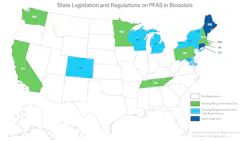
Legislation and regulation of PFAS chemicals in biosolids
Absent federal action, more state and local governments are enacting their own statutes and regulations on PFAS in biosolids. Notably, Tennessee adopted mandatory PFAS testing for biosolid-derived agricultural fertilizer just two weeks after the district court dismissed Farmer.7 In the 2025-2026 legislative sessions, roughly a dozen states considered an array of proposed new laws on PFAS in biosolids.8
At least sixteen states now have statutes or regulations addressing PFAS in biosolids. Fourteen states require companies or waste treatment facilities to test biosolids for PFAS and report the results to government regulators. Six of those states also limit biosolid use based on PFAS levels.9 The Virginia legislature passed a bill that includes PFAS testing and use restrictions on biosolids, although the governor has not yet signed the bill into law.10 Only Maine and Connecticut prohibit land application of biosolids that contain any PFAS, functionally banning biosolids.11 Other states appear hesitant to adopt similar blanket bans, perhaps due to Maine’s mounting waste management crisis.12
Even without legislative limits on PFAS in biosolids, state and local governments may withhold or suspend operational permits in response to PFAS testing data (or public concern generally). The primary wastewater treatment plant for Arlington County, Virginia, for example, is currently facing opposition to the renewal of its state permits due to concerns about PFAS contamination, including specifically via biosolids.13
What litigation looks like across the U.S.
Growing attention to biosolids as a potential vehicle for PFAS soil and water contamination is fueling litigation not only against businesses discharging wastewater but also against outside entities involved in wastewater treatment, biosolids processing, land-spreading of biosolids, or the sale of biosolids-derived products.



To date, most PFAS lawsuits involving biosolids have primarily targeted businesses alleged to have PFAS in their wastewater, although entities that treated the wastewater or handled the resulting biosolids are often named as additional defendants. For instance, in litigation concerning allegations of PFAS-contaminated wastewater from a textile mill, plaintiffs sued (among others) the town that operated the publicly owned treatment works that handled the mill’s wastewater and land-spread the resulting biosolids.14
More recent PFAS litigation, however, has included cases focusing on the conduct of wastewater management and biosolids companies. Most notably, a lawsuit in federal court alleges that the land application of a biosolid-derived fertilizer produced and marketed by Synagro Technologies, Inc. to farmland in Texas caused PFAS contamination of soil and water in the area.15 If those claims succeed, the case could spawn similar litigation elsewhere in the country and/or against other companies involved in the processing or sale of biosolids.
Even when there are no allegations of PFAS contamination, litigation may target companies involved in biosolids. For example, in Beyond Pesticides v. Scotts Miracle-Gro Co., a nonprofit organization brought a so-called “greenwashing” claim against a fertilizer manufacturer, alleging that advertising its biosolids-derived product as “eco friendly” was deceptive marketing when it allegedly contained PFAS.16
Preparation and response
Legal developments concerning PFAS in biosolids have significant implications for both the wastewater management and biosolids industries as well as for businesses whose wastewater may contain PFAS, especially if those businesses also handle their own wastewater treatment or sewage sludge disposal. Managing this rapidly evolving legal landscape requires advanced preparation for compliance and potential litigation.
Impacted companies should work with appropriate outside counsel to monitor state and local regulation of PFAS in biosolids. When appropriate, businesses handling PFAS should evaluate potential changes to corporate practices related to wastewater and biosolids. Staying up-to-date on legal developments allows businesses to plan to efficiently implement any necessary changes and avoid operational disruptions.
Companies involved with biosolids may also consider engaging in individual or collective efforts to promote state and local policies that address public health concerns while still accommodating waste management needs and avoiding unnecessary compliance burdens.
If a company faces possible government action or private litigation, retaining counsel with extensive experience in PFAS litigation is critical. Contamination cases require expertise in both the relevant science and applicable law, and PFAS cases present unique technical issues due to the compounds’ ubiquity and the complexity of reliable testing. Proper preparation for these challenges may decrease the likelihood of governmental or private litigation and can strengthen defenses if litigation does occur.
Resources & citations
- EPA, Draft Sewage Sludge Risk Assessment for Perfluorooctanoic Acid (PFOA) and Perfluorooctane Sulfonic Acid (PFOS), 90 Fed. Reg. 3859, 3860 (Jan. 15, 2025) (Figure 1).
- Id.
- Standards for the Use or Disposal of Sewage Sludge, 40 C.F.R. Part 503.
- Id.; see also EPA, Land Application of Biosolids, https://www.epa.gov/biosolids/land-application-biosolids.
- EPA, Draft Sewage Sludge Risk Assessment for PFOA and PFOS (Jan. 2025), https://www.epa.gov/system/files/documents/2025-01/draft-sewage-sludge-risk-assessment-pfoa-pfos.pdf.
- Farmer v. EPA, 805 F. Supp. 3d 253 (D.D.C. 2025) (appeal filed).
- Tenn. Farm Bureau, Biosolid Application and Local Government Regulation, https://tnfarmbureau.org/wp-content/uploads/2025/08/Biosolid-Application-and-Local-Government-Regulation.pdf.
- See Safer States, Safer States: Bill Tracker, https://www.saferstates.org/bill-tracker/?states=All&status=All&toxic_chemicals=PFAS&issue_sectors=Biosolids/Sludge (last visited Mar. 3, 2026).
- Compare California; Massachusetts; Minnesota; New Hampshire; Pennsylvania; Rhode Island; Tennessee; Washington (testing only) with Colorado; Maryland; Michigan; New York; Vermont; Wisconsin (testing and use restrictions).
- Compost and other products containing organic soil amendments infrastructure; DEQ tax policy option, Virginia State Legislative Information System, https://lis.virginia.gov/bill-details/20261/SB226 (last visited April 3, 2026).
- Maine L.D. 1911, An Act to Prevent the Further Contamination of the Soils and Waters of the State with So-called Forever Chemicals; Connecticut Public Act No. 24-59, An Act Concerning the Use of PFAS in Certain Products.
- Sydney Cromwell, Inside Climate News, Maine Was First To Ban Spreading PFAS-Contaminated Sludge on Farmland. Now Sludge Is Filling up Landfills, https://insideclimatenews.org/news/24112025/maine-landfill-pfas-contamination/.
- Lisa Fletcher, Virginia DEQ faces scrutiny over wastewater permit tied to PFAS discharge, sludge, WJLA, https://wjla.com/features/i-team/virginia-deq-faces-scrutiny-over-wastewater-permit-tied-to-pfas-discharge-and-sludge-forever-chemicals-department-of-environmental-quality-farmland-fertilizer-arlington-county.
- See Complaint, Parris v. 3M Co., No. 4:21-cv-00040-TWT (N.D. Ga. Feb. 23, 2021), ECF No. 1.
- Second Amended Complaint, Alessi v. Synagro Techs., Inc., No. 3:25-cv-00445, ECF No. 36 (N.D. Tex. Apr. 4, 2025).
- See First Amended Complaint, Beyond Pesticides v. Scotts Miracle-Gro Co., No. 2024-CAB-006782 (D.C. Super. Ct. May 23, 2025).
About the Author
 Gary Feldon
Gary Feldon
Partner, Hollingsworth LLP
Gary Feldon is a partner at Hollingsworth LLP, where his practice focuses on complex litigation, toxic torts, pharmaceutical and medical device cases, and products liability litigation.
 Joseph D. Cianciola
Joseph D. Cianciola
Associate, Hollingsworth LLP
Joseph D. Cianciola is an associate at Hollingsworth LLP, where he is a member of the complex litigation, pharmaceutical, products liability, toxic tort, and insurance groups.
 Samuel J. Quinan
Samuel J. Quinan
Associate, Hollingsworth LLP
Samuel J. Quinan is an associate at Hollingsworth LLP, practicing complex litigation defense in pharmaceutical, products liability, and toxic tort matters.