What is energy recovery from wastewater?
Key Highlights
- Energy recovery from wastewater involves harnessing methane from biogas.
- Chemical energy, gravitational potential energy, and salinity gradient energy are the three forms of energy that can be harnessed at wastewater treatment plants.
- Anaerobic digestion of activated sludge and concentrated organic compounds is commonly used at wastewater treatment plants to harness methane.
- Other strategies to harness energy include microbial fuel cells that uses electrodes.
- Thermal hydrolysis is commonly used prior to anaerobic digestion and produces biogas.
- Although the purpose of energy recovery at wastewater treatment plants is to reduce greenhouse gas emission because methane is a greenhouse gas and to reduce operating costs, there are reported concerns about methane losses during the anaerobic digestion process.
The Piscataway Bioenergy Facility at the Washington Suburban Sanitary Commission (WSSC) Water, Maryland’s largest water utility, employs sludge digestion to produce biogas that be upgraded to renewable natural gas quality. This $271 million project completed in Spring 2025 made possible by the partnership between the State of Maryland, EPA, and WSSC Water, is anticipated to generate $700,000 per year from the sale of natural gas.
The Piscataway Bioenergy Facility is among the list of energy recovery efforts by wastewater treatment plants in the United States using federal, state, and local governments programs to promote green energy. Wastewater treatment plants are the largest energy consumers using 30 to 40 % of total energy consumed.
And that is not the only concern – because they contain sludge, wastewater treatment plants generate over 45 million tons of greenhouse gases annually and thus, significantly contribute to global warming. To resolve these issues, the EPA along with several states are promoting energy efficiency programs to recover and utilize the energy produced during wastewater treatment, also known as wastewater energy recovery.
How is energy recovered from wastewater?
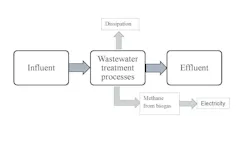
In a wastewater treatment plant, the influent undergoes treatment processes where energy is harnessed in the form of biogas containing methane as shown in Figure 1. When processed at facilities such as a biogas collection facility, the purified methane can be used to produce electricity.
What strategies enable energy recovery at wastewater treatment plants?
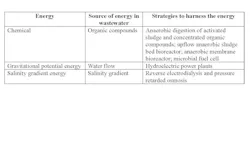
Chemical energy, gravitational potential energy, and salinity gradient energy are the three forms of energy that can be harnessed. Among the strategies listed in Table 1 that enable energy recovery, anaerobic digestion of activated sludge and concentrated organic compounds is commonly utilized at wastewater treatment plants.
In anaerobic digestion, microorganisms present in the wastewater treatment plant break down biosolids in the sludge and organic compounds into simpler compounds and produce biogas as an end product. The biogas contains methane besides carbon dioxide and trace amounts of water and nitrogen. Methane can be purified and harnessed to supply electricity.
A strategy to produce electricity without producing methane is the use of microbial fuel cells. Relatively less common than the other strategies listed in Table 1, microbial fuel cells assist in harnessing chemical energy in wastewater treatment plants. The breakdown of organic matter in wastewater by microorganisms releases electrons that are transferred to the electrodes – vital components in the microbial fuel cell setup – to produce electricity.
There is also another common strategy that also produces methane – thermal hydrolysis. Prior to anaerobic digestion, the sludge in the wastewater treatment plants is treated by thermal hydrolysis. In thermal hydrolysis, organic compounds in the sludge are subjected to high temperature and pressure required for the hydrolysis reaction. Thermal hydrolysis produces biogas and methane can be purified from this biogas while the sludge from the thermal hydrolysis process can then be used for anaerobic digestion to also produce biogas.
Comparison of energy recovery strategies
A comparison of some of the strategies for harnessing energy from wastewater showed that compared to anaerobic digestion of activated sludge, energy recovery is at least two times higher for anaerobic digestion of concentrated organic compounds.
However, chemical energy recovery from organic compounds depends on the concentration of biodegradable components present in the influent and on the chemical factors in the wastewater treatment plants that control the efficiency of anaerobic digestion. The recovered chemical energy yield can have lower practical use than thermal energy derived from the effluent.
An example to understand the practical difference between chemical and thermal energy recovery is an evaluation done on a large-scale municipal wastewater treatment plant in Beijing, China. The results showed that only about 13% of the total theoretical energy in the influent could be converted into electricity compared to thermal energy in the effluent that could be utilized to meet some of the operational energy demands.
What are the benefits of energy recovery in wastewater treatment plants?
Because methane constitutes 11% of global greenhouse gas emission, it is theoretically beneficial to harness methane to minimize atmospheric emission. However, the practical benefit of energy recovery is the use of thermal hydrolysis.
Thermal hydrolysis eliminates harmful pathogens from the sludge. Used as a pretreatment for anaerobic digestion at some wastewater treatment facilities, thermal hydrolysis also improves biogas production. When used on the digestate, which is the resulting product from anaerobic digestion, thermal hydrolysis at 160oC enhances methane yield by three folds.
Can wastewater energy recovery reduce operational costs?
Yes, theoretically wastewater energy recovery can reduce operational costs because the recovered energy can be sold or re-used to supply power to the wastewater treatment plant. However, this perspective should be approached with precautions due to methane loss.
According to the International Energy Agency, wastewater treatment plants can experience methane losses including during the anaerobic digestion process. To get a specific scenario of how serious this issue is, a recent study found that the methane leakage rate ranged from 0.4% to 65% based on compiled leakage data from wastewater treatment facilities and available literature.
The Piscataway Bioenergy Facility is an example of what wastewater treatment facilities in the US are doing to recover energy from wastewater, specifically to harness biogas. However, there is still a need to address the loss of methane, a greenhouse gas and an integral component of biogas.
About the Author
 Saleha Kuzniewski
Saleha Kuzniewski
Saleha Kuzniewski, Ph.D. has authored several publications in the fields of scientific research, biotechnology, and environmental regulations. She is the winner of the 2023 Apex award for publication excellence. She is also the founder of Environmental Remediation & Innovations, LLC. Kuzniewski can be reached at [email protected].