What is moving bed biofilm reactor (MBBR)?
Key Highlights
- A moving bed reactor (MBBR) is a specific type of biological wastewater treatment system for treating organic pollutants and nutrients from the wastewater.
- The main components of an MBBR system are the basin, plastic carriers, aeration grid, and the sieves. The biofilm is on the plastic carriers where biological treatment occurs.
- Design parameters such as the length to the width ratio of the basin, the density and shape of the plastic carriers, hydraulic retention time, and aeration time affect the performance of the MBBR.
- The plastic carriers are typically made of high-density polyethylene.
- Higher effective sludge retention time, low hydraulic retention time, resistance to shock load, and lower sludge production compared to other biological treatments are the key advantages of using an MBBR for wastewater treatment.
- Activated sludge process, trickling filter wastewater treatment, and membrane bioreactor all involve biodegradation of wastewater. However, they are different in the quantity of organic load they can handle and the materials used.
- Clogging is a common problem in trickling filter wastewater treatment and fouling is an issue in membrane bioreactors.

Moving bed biofilm reactors (MBBRs) are a specific type of biological wastewater treatment systems for treating organic pollutants and nutrients from the wastewater. Their key feature is the plastic carriers that is enriched with the biofilm. Although the biological processes for biodegradation can be complex, higher effective sludge retention time, lower hydraulic retention time, resistance to shock load, and lower sludge protection are the key advantages of using an MBBR for wastewater treatment.
What is biological wastewater treatment?
Biological wastewater treatment uses microorganisms to treat chemicals in wastewater. In some wastewater treatment plants, biological wastewater treatment occurs after primary treatment.
What is moving bed biofilm reactor (MBBR) wastewater treatment?
A moving bed biofilm reactor (MBBR) is a specific type of biological wastewater treatment. It is called a moving bed biofilm reactor because one of the components in it, called the MBBR chip, moves around to create a constantly changing chemical environment for the growth of a biofilm.
How does the MBBR wastewater treatment process work?
The MBBR wastewater treatment works using four main components to degrade the organic matter in the effluent via the actions of microorganisms on the biofilm. These components are:
Basin: The basin is also known as the reactor or the aeration tank where the influent enters and the MBBR process occurs. The size and the addition of a second basin depends on the wastewater treatment facility.
Media: As much as 50% to 70% of the basin is filled with the media. The media consists of small plastic chips and they have surface area adequate for biofilm growth. The plastic chip mixes in the fluid rather than float or sink due to its shape. It could be circular with a hollow in the center to allow it to mix in the fluid and it also contains interstitial space to allow for the effluent movement through it. As the effluent moves through the plastic chip, the biofilm on the plastic chip treats the organic matter. The organic matter is present in the effluent.
Aeration grid: The aeration grid is essentially a fan located at the bottom of the reactor tank that helps the media to move throughout the tank. Besides aerating the tank, it helps the media to come in contact with the wastewater for microbial degradation to occur.
Sieve: The sieve is a mesh material that allows water to pass through but keeps the plastic chips in the basin.
The influent enters the basin and the organic matter in the influent is transformed by the microorganisms in the biofilm into harmless end products. The biofilm is on the submerged plastic chips. The aeration grid aerates the tank and keeps moving the wastewater and plastic chips while the sieve allows the water to pass through while keeping the plastic chips in the basin. The biodegradation mechanisms by the biofilm does not necessarily have to be aerobic degradation. Anoxic processes including denitrification can also occur by the biofilm.
Effects of design parameters on the performance of the MBBR
An MBBR may be a single reactor or configured as several reactors in series. Several design factors affect the performance of the MBBR. These are as follows.
L:W ratio
Typically the length to width ratio (L:W) in an MBBR is in the range of 05:1 to 1.5:1 and a L:W greater than 1.5:1 can result in the non-uniform distribution of the plastic carriers in the tank. This can lead to poor oxygen transfer efficiency in the system and thus poor biofilm performance.
Plastic carriers
The density of the plastic carriers affects their ability to float and therefore mix in the basin. For example, heavier plastic carriers with a density of 0.98 g/cm3 require power for uniform distribution while slightly buoyant carriers have a specific gravity of between 0.94 and 0.96 gm/cm3.
Hydraulic retention time (HRT)
The hydraulic retention time (HRT) refers to the amount of time the bioreactor needs to effectively treat the influent wastewater. As such, HRT affects the performance of the biofilm on the carriers in the MBBR.
A study showed that a higher HRT of 24 hours had high removal efficiency of organic pollutants and nutrients at54% chemical oxygen demand (COD) removal and 96% total phosphorus removal. Another study showed that an HRT of 4.9 hours removed close to 50% of COD but only 32% COD removal occurred at a lower HRT of 1.6 hours.
Aeration rate
The aeration rate affects the composition of the biofilm in the plastic carriers which in turn affects the biodegradation efficiency of the wastewater. For example a study showed that at an optimal aeration rate of 1 mL/min, 86.2% of total nitrogen and 93.8% of COD was removed from an MBBR system treating nitrate wastewater. The study also revealed the key microorganisms involved in this biodegradation and that at a lower aeration rate, some microorganisms were more prominent than others in the wastewater denitrification process.
Mechanical mixing devices
Mechanical mixing devices are used in MBBRs that carry out denitrification. Here, the mechanical mixers agitate the bulk of the liquid and uniformly distribute the plastic carriers.
However a study showed that irrespective of the mixing conditions, a small scale MBBR always performed at no more than 80% of the capacity of a medium scale system. It suggested that this occurred because oxygen diffusion becomes limiting at high total ammonia nitrogen.
What media is used in the MBBR processes?
The media used in the MBBR process is basically plastic chips. In literature, these are referred to as MBBR media, MBBR carriers, or MBBR chips. The MBBR chips are typically made of high-density polyethylene (HDPE) and microorganisms from the wastewater settle on this to form a biofilm. The large surface area per unit volume of the MBBR chips allows for a large area of contact between the wastewater and the biofilm. Organic matter from the wastewater is biodegraded by the biofilm on the MBBR chips resulting in the production of carbon dioxide, water, and other harmless end-products.
A recent study showed that the shape of the plastic carrier affects the hydrodynamic properties and thus removal efficiency of pollutants from wastewater. Specifically, the study used saddle-shaped plastic carriers that had a specific surface area of 700 m2/m3 and more than 87% porosity. The study reported that the saddle shape played a role in conferring better hydrodynamic properties to the plastic carriers and higher removal efficiency of nitrogenous pollutants from the wastewater compared to plastic carriers without the saddle shape and with lower porosity.
Why is MBBR used in wastewater treatment?
MBBR not only treats organic wastes but it can also be used to treat other pollutants in the wastewater. For example, it can be used to treat process water from the pulp and paper manufacturing, remove dyes in wastewater from textile factories, and effluents from the dairy processing plants.
What are the advantages of MMBR?
MBBR is a simple process for biological wastewater treatment. An MBBR aeration tank can effectively treat the same amount of wastewater as a much larger traditional tank and so it is a compact treatment system. Other advantages of MBBR are:
Higher effective sludge retention time (SRT): SRT is the length of time that a particular unit of biological media is actively working within the bioreactor. This unit of biological media in an MBBR is the plastic chips (also known as plastic carriers). In the MBBR, the plastic chips are kept within the reactor by the mesh sieve and so none of the biofilm is lost and as a result, the SRT is higher in an MBBR than in other biological waste treatment systems.
Resists shock load: Wastewater can contain toxins that can kill the bacteria in the biological media. However, the biofilm in the MBBR can respond to and recover from such toxins and that is why MBBR can resist shock load. The ability of a biofilm to respond to and recover from wastewater toxins depends on the microbial composition of the biofilm.
Low hydraulic retention time (HRT): HRT refers to the average amount of time the wastewater stays in the reactor. The HRT is shorter for the MBBR than for other biological waste treatment systems. This is attributed to the plastic carriers, a key component of the MBBR wastewater treatment system. The high bacterial concentration in the biofilm on the carrier and the high surface area for contact with the wastewater results in shorter HRT for MBBR compared to for other biological treatment systems.
Lower sludge production: MBBR is a fixed film system, meaning it has biofilm on the plastic carriers and the sieve mesh prevents the biofilm from being lost. Additionally, nothing is added to the effluent and so the resulting sludge is of a lower volume unlike for other biological treatment systems where additives are used resulting in more sludge production.
What are the disadvantages of MBBR?
The main disadvantage of using the MBBR is the need for operator training because the biological processes that occur in an MBBR can be complex.
How does MBBR compare to other wastewater treatment processes?
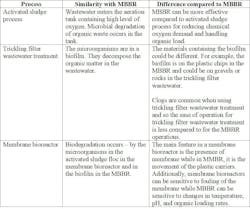
Other wastewater treatment processes, namely activated sludge, trickling filter wastewater treatment, and membrane bioreactor share basic similarity with MBBR because they all involve the biodegradation of pollutants present in the wastewater.
However as Table 1 shows, these wastewater treatment processes are also different from MBBR in terms of the materials used in their components and their operational challenges.
Table 1: Comparison of activated sludge process, trickling filter wastewater treatment and membrane bioreactor with MBBR
Take a quiz on MBBRs
About the Author
 Saleha Kuzniewski
Saleha Kuzniewski
Saleha Kuzniewski, Ph.D. has authored several publications in the fields of scientific research, biotechnology, and environmental regulations. She is the winner of the 2023 Apex award for publication excellence. She is also the founder of Environmental Remediation & Innovations, LLC. Kuzniewski can be reached at [email protected].