How HRSD transforms wastewater into a groundwater resource
Key Highlights
- The Potomac Aquifer has experienced over 200 feet of water level decline due to heavy groundwater withdrawals, impacting land stability and sea level rise.
- HRSD's SWIFT initiative treats wastewater to drinking water standards and recharges the aquifer, aiming to inject up to 100 million gallons daily, supporting regional water sustainability.
- Garney set a world record in 2024 by installing the longest 42-inch HDPE pipe beneath the James River using horizontal directional drilling, reducing costs and environmental impact.
- Upgrades at the Nansemond Treatment Plant expand capacity to 50 MGD, incorporating advanced nutrient removal and treatment technologies to improve water quality and resilience.
- The Nansemond SWIFT Facility employs ozone, biofiltration, GAC, and UV disinfection to produce recharge-quality water, with operations expected to begin in 2029, ensuring long-term aquifer health.
Eastern Virginia has faced groundwater challenges for more than a century. The Potomac Aquifer, the region's primary drinking water source, has been so heavily utilized that water levels have dropped dramatically. According to the U.S. Geological Survey, groundwater withdrawals have lowered water levels by more than 200 feet in some areas. That kind of change affects more than just the water supply. It causes the land itself to sink, speeds up the effects of sea level rise, and opens the door to saltwater creeping into freshwater sources.
The Hampton Roads Sanitation District (HRSD) launched its Sustainable Water Initiative for Tomorrow (SWIFT) in 2016 to tackle these challenges. Rather than discharging treated wastewater into local rivers, SWIFT treats it further to meet drinking water standards and returns it to the Potomac Aquifer. At full scale, HRSD will be able to recharge the aquifer with up to 100 million gallons of purified SWIFT Water — a registered trademark — every day.
Garney, a national water and wastewater contractor with 3,000 employees and 19 regional offices, is helping make this vision a reality through five major projects: the James River Crossing subaqueous and land force mains, the Nansemond Treatment Plant upgrades and capacity expansion to 50 MGD, and the Nansemond SWIFT facility and recharge wells. Together, these projects form critical links in the reclaimed water treatment chain that will support managed aquifer recharge for decades to come.
Setting a world record under the James River
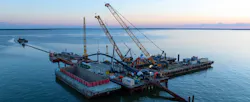
The James River Crossing project presented one of the most complex engineering challenges in the SWIFT program. The goal was to install a large-diameter force main beneath the James River to convey wastewater from the Boat Harbor Pump Station in Newport News to the Nansemond Treatment Plant in Suffolk. The subaqueous force main had to pass under the Newport News Shipping Channel, the sixth-busiest port in the United States, without disrupting maritime traffic.
Using horizontal directional drilling (HDD), Garney set a world record in May 2024 by completing the longest pullback ever recorded for a 42-inch high-density polyethylene (HDPE) pipe. In just 22 hours, crews pulled the 5,700-foot-long string of butt-fused HDPE pipe through a bore more than 100 feet beneath the riverbed.
The collaborative approach among Garney, engineer Dewberry, Huxted Trenchless and HRSD led to major savings and reduced risk. Early in the project, the team redesigned the alignment to extend the drill to the shoreline, adding 1,400 linear feet to the bore length. That change eliminated the need for a second marine platform and open-cut trenching in the river, cutting more than $10 million from the project cost while reducing environmental impact.
Garney wrapped up the subaqueous work in July 2025, and pipe crews are now pushing toward final connections to the Nansemond Treatment Plant on land. This phase includes nearly 6,700 linear feet of 48-inch force main, more than 2,900 linear feet of SWIFT finished water main, 3,600 linear feet of SWIFT backflush water main, and a 400-foot microtunnel passing beneath Interstate 664.
Advanced Water Treatment to Recharge the Aquifer
The Nansemond Treatment Plant and Nansemond SWIFT Facility are where raw wastewater becomes SWIFT Water, purified to drinking water standards and conditioned to match the chemistry of the Potomac Aquifer.
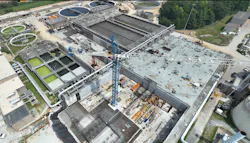
Garney is leading the design-build effort for the Nansemond Treatment Plant Advanced Nutrient Reduction Improvements project, which includes upgrades with treatment process intensifications and expanding the plant's capacity from 30 MGD to 50 MGD. This additional capacity will accept flow from the former Boat Harbor Wastewater Treatment Plant, which is being converted to a pump station as part of the consolidation strategy.
The upgrade adds critical processes and new treatment, pumping, and electrical systems. Work includes new flow control and distribution box structures, upgraded chemical feed systems, expanded effluent pumping supported by three 700-hp vertical turbine pumps, and a medium-voltage switchgear building with plant-wide duct banks to strengthen power reliability with modernized equipment. New treatment infrastructure includes a 95-foot primary clarifier, two 160-foot secondary clarifiers, two aeration tanks with fine-bubble diffusers, a 4 MG equalization basin, gravity thickeners with odor control, centrifuge dewatering, and a new return activated sludge and waste activated sludge pump station. Together, these upgrades enhance nutrient removal, improve storm resilience, and incorporate some of the most cutting-edge treatment processes.
Once wastewater moves through the upgraded treatment plant, it continues to the Nansemond SWIFT Facility for advanced purification. Garney is leading construction of both the SWIFT facility and the on-site managed aquifer recharge (MAR) wells.
The SWIFT Facility adds the advanced treatment systems needed to produce recharge-quality water. The process starts with coagulation and sedimentation to remove suspended solids, followed by ozone treatment that breaks down organic compounds. Biologically active filtration uses natural microbial processes to further polish the water. Granular activated carbon (GAC) adsorption targets trace contaminants including per- and polyfluoroalkyl substances (PFAS), and ultraviolet disinfection provides a final barrier against pathogens. Before recharge, the water is conditioned to match the geochemistry of the existing groundwater, protecting the aquifer structure.
HRSD chose this carbon-based treatment approach over membrane processes like reverse osmosis for good reason. Coupled with the highly treated effluent from the wastewater plant, the ozone-biofiltration-GAC train achieves equal treatment performance while eliminating the concentrated brine waste stream that reverse osmosis produces. It is a more sustainable approach that avoids creating a new waste stream while redirecting the original one.
When complete, the Nansemond SWIFT Facility will deliver up to 34 million gallons of SWIFT Water daily through a network of up to 19 managed recharge wells. The facility is expected to begin operations in 2029.
Proven Science, Careful Monitoring
SWIFT is the result of years of research and demonstrations, not an experiment. The SWIFT Research Center at the Nansemond Treatment Plant opened in May 2018 and has been recharging up to one million gallons of SWIFT Water daily ever since. That operational track record, combined with extensive monitoring by HRSD and the U.S. Geological Survey (USGS), provides the foundation for scaling up to full production.
USGS installed extensometers at the research center to measure how the aquifer responds to recharge. These instruments can detect when water is being withdrawn for maintenance and when recharge resumes, confirming that SWIFT is having a measurable impact on aquifer behavior. As full-scale facilities begin operating at higher volumes in 2026 and beyond, continued monitoring will track how those benefits extend across the region.
Critical control points throughout the advanced treatment process allow strict, real-time monitoring. If any parameter falls outside specifications, SWIFT Water is automatically diverted away from the recharge wells and sent back to the treatment plant. This fail-safe approach ensures that only water meeting drinking water standards enters the aquifer.
Looking Ahead
The James River Crossing and Nansemond projects represent significant pieces of a larger puzzle. SWIFT is designed to eventually operate at HRSD’s other treatment facilities, creating a regional system capable of sustainable aquifer recharge at scale.
What makes SWIFT compelling is how it addresses multiple challenges simultaneously. It restores a depleted groundwater resource. It reduces nutrient pollution in the Chesapeake Bay. It helps slow land subsidence that compounds sea level rise. And it does all of this by treating wastewater as a resource rather than a waste stream.
For Garney, delivering the conveyance and treatment infrastructure for SWIFT means being part of a project that will benefit the region for generations. The world record under the James River is a milestone worth celebrating, but the real measure of success will be the long-term impact: a healthier Chesapeake Bay, a recharged aquifer, a more resilient coastline, and a sustainable water future for Hampton Roads.
About the Author
 Matt McKinnon
Matt McKinnon
Regional Operations Manager at Garney
As Regional Operations Manager, Matt McKinnon oversees Garney’s water and wastewater plant operations across Virginia. With more than 15 years of experience on complex heavy civil projects, he leads major projects under Hampton Roads Sanitation District’s Sustainable Water Initiative for Tomorrow (SWIFT), including the Nansemond Treatment Plant Expansion and SWIFT Facility. Matt brings insight into alternative delivery, reclaimed water strategies, and early contractor involvement to advance sustainable water reuse solutions.