How low DO nutrient removal can achieve ESG goals
Key Highlights
- WRRFs are increasingly adopting ESG-focused practices, including nutrient removal and GHG emission reduction, to enhance community stewardship and watershed health.
- Controlling nitrogen discharge and optimizing low DO operation can reduce energy use and N2O emissions, contributing to sustainability goals.
- Proper management of carbon sources during denitrification is crucial for minimizing N2O emissions, with research indicating that stable, long-term process control is effective.
- Regulatory efforts, such as nutrient limits in Chesapeake Bay and other states, drive improvements in nutrient removal and environmental protection.
- Emerging operational strategies, including gradual process transitions and tailored carbon dosing, offer promising avenues for balancing nutrient removal with GHG mitigation in wastewater treatment.

Water resource recovery facilities (WRRFs) are increasingly focused on community stewardship through environmental, social and governance (ESG) goals. At WRRFs, these often include a focus on climate and watershed health and carbon footprint reduction. WRRFs are a notable source of direct and indirect greenhouse gas (GHG) emissions which contribute significantly to their carbon footprint. Direct emissions, also known as scope 1 GHG emissions, include carbon dioxide (CO2), methane (CH4) and nitrous oxide (N2O) that are emitted directly from the WRRF. Indirect emissions include scope 2 and 3 emissions that are a consequence of the wastewater treatment operation but do not occur at the facility itself. This includes scope 2 indirect energy emissions from purchased energy, and scope 3 emissions, which include all other indirect emissions from the supply chain of chemical and other raw materials, including production, transportation and application.
Notably, WRRFs are one of the major sources of N2O. According to the USEPA, N2O is a potent greenhouse gas with a global warming potential 273 times greater than CO2.During wastewater treatment, N2O is produced as an unintended by-product of biological nitrogen removal via nitrification and denitrification processes. Increasing evidence suggests that a focus on nutrient removal and GHG reduction can go hand-in-hand to achieve WRRFs’ ESG goals through practices that minimize process instability and reduce energy demand.
Controlling nutrient removal to minimize emissions
Achieving ESG goals at WRRFs requires nutrient removal to protect receiving waters. The negative impacts of eutrophication resulting from phosphorus and nitrogen pollution on water quality are well documented. In recent years, increased focus on reducing nutrient load from WRRFs on receiving waters has manifested in lower effluent nutrient limits. Early adopters of stringent nutrient limits include WRRFs in the Chesapeake Bay area in the District of Columbia, Maryland, Pennsylvania, and Virginia. As early as 1983, the Chesapeake Bay Agreement required a 40% reduction in effluent nutrients. In 2010, the EPA established the largest ever total maximum daily load for nutrients in the Chesapeake Bay, leading to a 27% reduction in effluent total nitrogen (TN) across wastewater treatment plants by early 2025.
Other states including California, Minnesota and Colorado have begun implementing TN limits as part of their nutrient reduction strategies. Improving nitrogen removal at the treatment plant reduces the amount of nitrogen released and subsequent N2O production in the receiving water body. Based on 2019 IPCC emission factor guidelines, nitrogen discharged to waters could lead to approximately 20% more N2O emissions than treating the same amount of nitrogen in an engineered and controlled environment at WRRFs (Downing et al., 2025)[1]. It should be noted that accurately estimating N2O production from water bodies is quite complicated and further research is merited on this topic. Regardless, ESG goals should consider balancing scope 1 N2O emissions from biological nitrogen removal with the emissions that would occur if that nitrogen were instead discharged into receiving waters.
 What is biological nutrient removal?
Low energy wastewater treatment
The operating dissolved oxygen (DO) concentration in the biological nutrient removal (BNR) process impacts both nutrient removal and GHG emissions during secondary treatment as DO concentration determines the redox environment that controls biochemical activity. Operating at a lower DO concentration than the traditional practice of at least 2 mg/L for complete nitrification is gaining momentum for both its nutrient removal and energy savings benefits. Complete nitrification has been observed below 0.5 mg/L DO in communities adapted to low DO conditions.
Aeration energy for activated sludge is one of the most energy intensive processes at WRRFs, estimated to contribute approximately 45 to 60 % of total energy demand at WRRFs operating at conventional DO setpoints. Low DO operation has the potential to significantly impact sustainability goals through reduced aeration energy demand. Salekar et al. 2025[2] estimated GHG emissions at a Texas WRRF using process models, comparing low DO operation with conventional DO operation with various levels of biodegradable carbon available for denitrification. The authors found that an average 29% reduction in indirect emissions due to lower aeration energy demand, combined with reduced chemical demand, outweighed the potential N2O emission increase at low DO setpoints. Specifically, the study estimated that low DO operation had a smaller carbon footprint and could emit up to 0.1 to 0.5 % more influent nitrogen as N2O without exceeding the footprint of high DO operation.
Low DO operation does have the potential to increase N2O emissions during nitrification through the nitrifier denitrification pathway. However, an increasing number of long-term studies suggest that with enough time allotted for microbial community adaptation during a slow transition from high to low DO and appropriate process control to create a stable redox environment, N2O emissions do not necessarily increase under low DO operation. For example, a Wisconsin WRRF monitored N2O emissions as the DO setpoint was lowered from 3.0 mg/L to 0.5 mg/L over five months. N2O emissions initially increased when DO levels were lowered but stabilized and returned to levels similar to that of high DO operation once the system adapted to the new conditions after approximately one month (Gutenberger et al., 2025)[3]. This echoes the findings from other ongoing research on N2O emissions in controlled low DO BNR systems.
At low DO, simultaneous nitrification denitrification (SND) can occur, which facilitates total nitrogen removal within the same process volume while minimizing the use of supplemental carbon for denitrification. While achieving SND is often a main goal of low DO operation, improved phosphorus removal may be an ancillary benefit at low DO. For example, at the same Wisconsin WRRF, improved biological phosphorus removal while adding less chemicals for phosphorus precipitation was observed during low DO operation. Other plants, including the Virginia Initiative Plant at HRSD, have observed a similar effect. This may be due to the reduction of aerobic ordinary heterotrophic organisms (OHO) activity and conservation of carbon for phosphate accumulating organisms (PAO), and/or via anoxic phosphorus uptake by denitrifying PAOs. While lower chemical use lowers scope 3 emissions, the impact of energy consumption on emissions is typically much more significant (Salekar et al., 2025).
Carbon cycling and N2O emissions
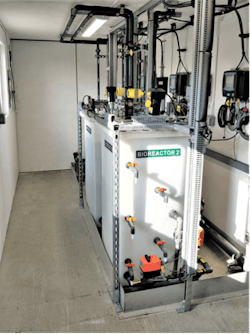
N2O emissions are impacted by carbon availability and speciation during the denitrification process (Song et al., 2024)[4]. In aerobic-anoxic sequencing batch reactor experiments conducted at Hayward Water Pollution Control Facility in California (Fig. 1), the impact of supplemental carbon types (glycerol-based MicroC and acetate-rich synthetic fermentate) and the carbon-to-nitrogen ratio (C/N ratio) were illustrated. Nitrite accumulation during denitritation (partial denitrification) was observed with both carbon types, while an order of magnitude higher N2O emissions were measured with MicroC compared to synthetic fermentate. Lower C/N dosing ratios also led to an increase in N2O emissions, illustrating the importance of ensuring adequate carbon for denitrification. Appropriate carbon management at a WRRF, both from internal and external sources, can therefore play a major role in mitigating N2O emissions.
Conclusions
Mitigating GHG emissions while achieving nutrient removal can help WRRFs achieve their ESG goals. Low DO operation should be considered as a viable method to achieve improved total nitrogen removal with less energy use, reducing indirect emissions. Emerging research has demonstrated that N2O emissions can be managed with operational adjustments, including gradual transitions during process changes, long-term stable setpoints with proper DO control, and appropriate selection of carbon type and dosing ratios.
Citations
1. Downing, L., Farmer, M., Bhattarai, B., Penn, M., Kozak, J., Grabowy, J., & Sabba, F. (2025). Making waves: Rethinking our mission for N₂O emissions at WRRFs. Water Research X, 28, 100320. https://doi.org/10.2175/193864718825159986
2. Salekar, P., Mallick, S. P., Bhattarai, B., McNamara, P. J., Downing, L., & Sabba, F. (2025). Operational implications of low dissolved oxygen in water resource recovery facilities: A simulation study on greenhouse gas emissions and carbon footprint reduction. Journal of Cleaner Production, 146891. https://doi.org/10.1016/j.jclepro.2025.146891
3. Gutenberger, G., Downing, L., Sadreddini, S., Biese, T., Watson, J., Elger, S., Koch, J., & Jordan, T. (2025, September). Emissions, energy, and performance: Low energy BNR at full scale. In Microbial selection and performance under low DO conditions. Proceedings of the Water Environment Federation. Water Environment Federation. https://doi.org/10.2175/193864718825159986
4. Song, C., Zhu, J.-J., Willis, J. L., Moore, D. P., Zondlo, M. A., & Ren, Z. J. (2024). Oversimplification and misestimation of nitrous oxide emissions from wastewater treatment plants. Nature Sustainability, 7(10), 1348–1358. https://doi.org/10.1038/s41893-024-01420-9
About the Author
Gretchen Gutenberger
Black & Veatch associate process engineer
Gretchen Gutenberger is an associate process engineer for Black & Veatch.