How digital twins position wastewater facilities for evolving challenges
Key Highlights
- Digital twins create virtual replicas of treatment plants, integrating real-time data with process models for enhanced operational insight.
- They enable safe scenario testing, forecasting, and optimization, reducing risks associated with manual adjustments and trial-and-error approaches.
- The technology addresses workforce challenges by capturing institutional knowledge and supporting training for newer operators.
- Recent advancements include machine learning integration, automated data quality checks, and AI-driven scenario analysis, making digital twins more accessible and powerful.
- Implementation at facilities like Metro Water Recovery demonstrates tangible benefits in energy efficiency, nutrient removal, and capacity planning, positioning plants for future automation and innovation.
Water resource recovery facilities across the U.S. are navigating an increasingly complex operational landscape. Regulatory requirements for nutrient removal continue to tighten while infrastructure ages, energy costs rise, and a generation of experienced operators approaches retirement. These converging pressures create operational challenges that exceed what traditional approaches can reliably address.
The complexity extends well beyond routine process control. As facilities manage population growth, climate variability, and fluctuating industrial discharges, operators face consequential decisions about aeration setpoints, solids retention times, chemical dosing rates, and long-term strategies with limited ability to forecast how adjustments will affect multiple treatment objectives simultaneously. Suboptimal choices can result in permit violations, excessive energy consumption, or unnecessary chemical costs, yet conventional methods offer little opportunity to test alternatives before implementation.
The human dimension of this challenge may be the most critical. Decades of operational knowledge reside largely with experienced staff nearing retirement. This institutional understanding, built through years of observing how specific facilities respond to varying conditions, transfers inefficiently to newer operators through traditional training methods. The industry needs tools that can systematically capture process behavior, remember past actions, enable safe scenario testing, and provide data-driven guidance across all experience levels.
Digital twins as a path forward
Digital twins represent a technological response to these operational challenges. Originally developed in the aerospace industry in the 1960s for monitoring complex systems under demanding conditions, digital twin technology has since matured across various sectors, including manufacturing, energy systems, and many others, before gaining traction in the water and wastewater industry.
While still in early stages of adoption within the water sector, recent literature reviews document over 147 peer-reviewed studies on digital twin applications across the urban water cycle, indicating growing research validation, technology maturation, and operational experience with the technology.
At their core, digital twins are virtual replicas of treatment processes that integrate real-time data with calibrated process models to mirror actual plant conditions and, as digital mirrors of the facility, enable operators to create, predict, and test unlimited scenarios to understand their plant, its process behavior, and identify optimization opportunities without risk to actual operations. Unlike traditional simulation models that operate independently from plant operations, digital twins maintain continuous connections to live data sources, allowing them to reflect current conditions and foresee system responses to potential changes.
The four interconnected components that make digital twins work
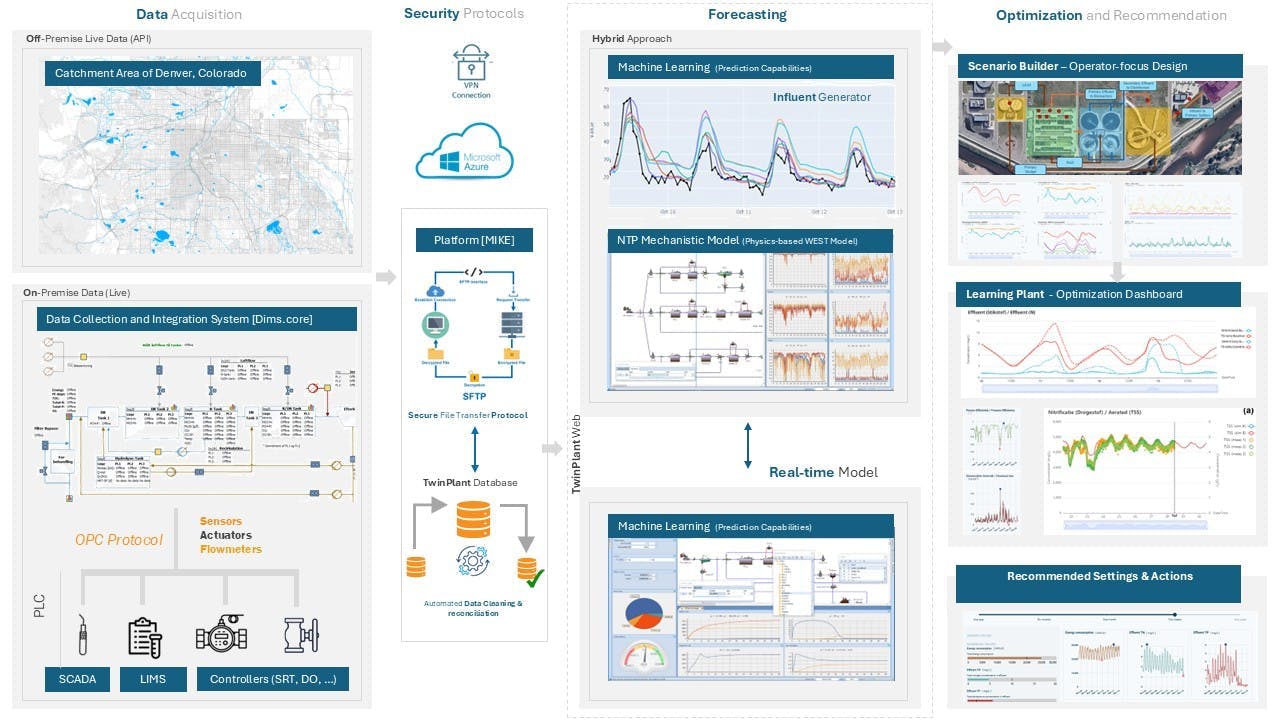
These tools work through four interconnected components. First, data acquisition systems collect information from online sensors that feed SCADA systems, laboratory analyses compiled in LIMS, and external data streams that provide weather forecasts and facility information.
Second, robust data processing routines clean and reconcile information, addressing sensor drift, outliers, and missing values to generate reliable datasets and avoid "garbage in, garbage out" problems.
Third, calibrated process models simulate treatment performance using established biological and chemical kinetics. While calibration represents one of the most tedious tasks, this phase often brings valuable insights into plant behavior and data management systems.
Fourth and finally, visualization and decision-support interfaces present insights that operators and engineers use to guide daily operations and longer-term planning.
Machine learning, automation, prediction and AI are evolving digital twin possibilities
Digital twins have undergone significant evolution. Early implementations primarily compared model predictions to historical data, requiring significant manual effort for calibration and interpretation.
Modern systems incorporate machine learning for influent forecasting, automated data quality checks, and sophisticated prediction capabilities. Some platforms now offer streamlined scenario-testing tools that enable operators to explore "what-if" questions under current plant conditions and evaluate potential operational changes before implementing them at full scale.
Looking ahead, the industry is actively working to transform the concept of agentic AI systems into reality, representing the next logical step in digital twins within the upcoming AI-enabled world. Once a digital twin is fully calibrated and connected, the right AI framework could automate, train, and receive continuous updates on facility-specific operational data, enabling operators to have direct conversations with their plant while proactively foreseeing needs and opportunities.
Imagine asking, "How is yesterday's wasting change impacting performance?" and receiving focused updates on key indicators with historical context and next day's projections and action items. Or requesting, "Run a sensitivity analysis on dropping dissolved oxygen by 0.3 mg/L" and having the system autonomously execute the analysis, forecast impacts on effluent quality and energy, check permit limits, and present recommendations, all within minutes.
These systems would operate like experienced process engineers, proactively monitoring conditions and routinely evaluating scenarios without being prompted.
Yet while this future takes shape, the industry must navigate present realities. The continuous evolution of digital twins continues to advance along multiple pathways, with software developers taking varied approaches depending on the needs and constraints of individual facilities.
Some implementations emphasize no-code SCADA connectors that prioritize accessibility and rapid deployment. While these approaches may appear less sophisticated, they often prove more practical and necessary for wastewater treatment plants with limited programming resources or IT infrastructure.
Other solutions leverage highly customizable Python-based frameworks that require programming expertise but open access to the vast universe of libraries and APIs that modern development environments provide. Artificial intelligence tools are increasingly making these capabilities accessible to non-traditional programmers, expanding who can build and maintain advanced systems.
Some of these solutions take advantage of cloud-based platforms that handle data processing and modeling remotely, offering computational power and automatic updates, while other solutions keep all processing on-premise for facilities with stringent cybersecurity constraints. This diversity of approaches reflects different philosophies about balancing ease of use with technical flexibility, with direct implications for which facilities can successfully implement and sustain these systems over time.
Real-world application at Metro Water Recovery
Metro Water Recovery's (Metro) Northern Treatment Plant (NTP) in Brighton, Colorado, provides a compelling example of digital twin implementation addressing multiple operational objectives.
The facility faced typical challenges amplified by local conditions: rapid population growth, increasing industrial variability, high operator attrition and changing weather patterns. Recognizing these pressures alongside evolving regulations, Metro embraced digitalization as a strategic opportunity.
Leadership understood that addressing energy optimization, nutrient removal, capacity planning, and knowledge transfer required a fundamental shift in managing operational data.
Brown and Caldwell partnered with Metro and DHI to develop a comprehensive solution. The system integrates process and lab data into a continuous pipeline using DHI’s management system for preprocessing and reconciliation. This generates high-quality datasets feeding a detailed process model built with WEST software, incorporating modified activated sludge model no.2d (ASM2d) libraries that could be used for future biological and chemical phosphorus removal plus optimization for recycle flows, step-feed operation, inventory management, chemical dosing, and aeration.
The system goes beyond what traditional models offer by remaining continuously updated with real-time data and offering forecasting capabilities that offer the ability to predict conditions up to 48 hours ahead. The system combines machine learning with mechanistic modeling for dynamic influent predictions, with chemical oxygen demand (COD) predictions correlating to laboratory data with errors of less than 15%, which when refined, could provide a tool for proactive rather than reactive operations.
The digital twin underwent extensive calibration and initial validation efforts against existing models and process data. Comparisons of model predictions with laboratory and online data indicate the need for continuous process model validations and calibration to maintain model output accuracy that would allow for reliability and trust amongst end-user groups. Validation remains an ongoing effort given the inherent complexity of the NTP process configuration (5-stage Bardenpho with step-feed for effectively 7 stages) and the shifting plant dynamics associated with a growing service area.
The digital twin approach may lead to promising opportunities for facilities exploring emerging operational strategies that many plants will need to adopt, including increasing simultaneous nitrification-denitrification, implementing low dissolved oxygen operation, and optimizing densification processes.
Moving Forward
Beyond its potential to support specific operational improvements at the NTP, the digital twin implementation positions Metro more advantageously as converging pressures push the water sector toward broader digital transformation in a rapidly evolving technological landscape.
As the industry moves toward increasingly autonomous and conversational systems, Metro's experience building this foundational digital infrastructure and developing staff capabilities to work with these tools may prove valuable as both global and operational challenges continue to intensify.
Early-adopting facilities are developing institutional understanding that extends beyond technical implementation, learning how to integrate model insights into daily decision-making and identify which capabilities deliver practical value under real-world constraints. This accumulated experience compounds as each model-informed decision refines system understanding and builds organizational competency.
For facilities evaluating their path forward, the relevant question appears less about whether digital capabilities will become necessary and more about when to begin implementing. Utilities starting now will develop the technical fluency and organizational capacity that may position them differently than those waiting several years, particularly as the industry works toward more sophisticated, accessible tools that fundamentally change how operators interact with treatment systems.