From non-revenue water to network resilience: Integrated Flow Solutions
Key Highlights
- Plug-and-play pressure management chambers by GF enable utilities to tackle water loss and regulatory targets.
- Pre-fabricated chambers by GF enable a faster, safer deployment in water networks.
- GF’s HDPE chamber integrates valves, measurement solutions and pipe connections in one system.

Non-revenue water (NRW) remains one of the most persistent challenges for water utilities worldwide. It combines lost production, lost revenue and accelerated infrastructure deterioration into a single operational burden. Globally, NRW is estimated at around 126 billion cubic meters per year, a volume that could supply roughly 800 million people. The associated economic impact is significant, with avoidable production and energy costs estimated at around USD 39 billion annually.
The challenge is particularly visible in markets where water networks continue to expand while aging infrastructure remains in operation. Brazil is a clear example. National benchmarking data shows that average distribution losses reach 37.78%, often communicated as “around 40%”. In practical terms, nearly four out of ten liters of treated water never generate revenue at the end user.
At the same time, regulatory expectations are increasing. Loss reduction targets are gradually moving toward 25% from 2033 onward, requiring utilities to implement solutions that are not only technically effective but also scalable and fast to deploy across multiple districts.
Pressure management as a key lever
Among the most effective strategies to reduce NRW is pressure management. Water networks in growing cities are frequently operated at higher pressures than necessary to ensure supply across large areas. However, excessive pressure increases leakage rates and accelerates mechanical stress on pipes and fittings.
Pressure reducing valves (PRVs) are therefore widely recognized as a highly effective intervention. By stabilizing pressure levels within district metering areas, PRVs reduce the flow rate of existing leaks while protecting infrastructure from unnecessary stress. Studies indicate that reducing the pressure of water networks by 25% can the occurrence of pipe bursts by up to 75%, while extending asset lifespan.
When combined with monitoring instruments such as sensors or flow meters, pressure management becomes a powerful tool for utilities seeking to improve both operational efficiency and network resilience.
Faster deployment through pre-fabrication
While technical performance is critical, utilities also need solutions that can be deployed quickly and reliably. Across the sector, skilled labour shortages and increasing project complexity are extending construction timelines.
Pre-fabricated infrastructure modules offer an effective response. By assembling and testing complex systems in controlled manufacturing environments, utilities can significantly reduce on-site installation time and minimize the risk of assembly errors.
Integrated plug-and-play systems therefore shift complexity away from the construction site toward standardized manufacturing processes. This approach improves installation predictability while reducing dependence on highly specialized labour.
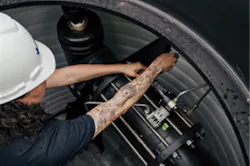
Pressure management is one of the most effective tools for optimizing the operation of water networks. Shown here is GF’s NeoFlow pressure reducing valve.
SABESP: a plug-and-play implementation
A recent project with Sabesp, Brazil’s largest sanitation company, demonstrates the practical benefits of this approach.
Sabesp supplies water and wastewater services to 375 municipalities in the state of São Paulo. As part of its network modernization program, the utility installed a NeoFlow Plug-and-Play pressure management chamber supplied by GF.
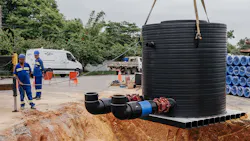
The compact system integrates several technologies into a single pre-assembled unit. At its core is the NeoFlow Pressure Reducing Valve, which stabilizes network pressure and reduces leakage rates. For the water inlet and outlet, Sabesp chooses the MULTI/JOINT 3000 Plus couplers that enable the safe connection of different pipe materials, allowing seamless integration into existing mixed-material networks.
The chamber itself is made of lightweight HDPE, which makes it up to 10 times lighter than traditional concrete structures. This significantly simplifies transport, installation and future maintenance. Because the system arrives fully assembled, installation at the Sabesp site required only half a day, including excavation, positioning and final connection. Compared with traditional construction methods, this dramatically reduces installation complexity, trench opening times and labour requirements.
Measurable results
The operational results of the installation are significant. The pressure management chamber saves approximately 130,000 cubic meters of water per year, equivalent to 130 million litres.
In financial terms, this translates into about €65,000 per year in avoided production and pumping costs, assuming an average production cost of €0.50 per cubic meter. In Brazilian currency, the annual savings correspond to roughly R$396,513. These figures indicate a payback period of around one year or less, even before accounting for additional operational benefits such as fewer pipe bursts, reduced emergency repairs and improved service continuity.
The environmental impact is equally important. The annual water savings are sufficient to supply around 3,000 people, while stabilized pressure also reduces energy consumption and protects infrastructure from mechanical stress.
Designed for long service life, the chamber itself can last up to 100 years, with internal components designed for around 50 years of operation. This helps reduce lifecycle costs while supporting long-term infrastructure sustainability.
From water loss reduction to network resilience
The Sabesp implementation demonstrates how integrated Flow Solutions can significantly reduce water losses without requiring large-scale network reconstruction. By combining pressure management, compatible materials and pre-fabricated system design, utilities can improve operational efficiency while strengthening infrastructure resilience.
As water networks worldwide face increasing pressure from climate change, urbanization and aging assets, such integrated approaches provide a practical and scalable pathway toward more sustainable water management.
Experience NeoFlow Plug-and-Play Chamber live at IFAT from 4-7 May in Munich, Germany:
- GF booth: B3.351
- VAG booth: C2.451
- https://go.gfps.com/ifat-2026
Media contact:
Constanze Werdermann
Senior Communications Manager, Industry & Infrastructure Flow Solutions, Global Communications
[email protected], +41 76 33 99 218
Corporate Profile
With a rich history in industrial innovation since 1802, GF is reshaping the future of Flow Solutions by delivering Excellence in Flow through mission-critical products and solutions that enable the safe and sustainable transport of water and other fluids for Buildings, Industry and Infrastructure. Headquartered in Switzerland, GF employs around 13’300 professionals across 46 countries. In 2025, GF’s Flow Solutions business generated sales of CHF 3 billion. GF is listed on the SIX Swiss Exchange.
You can register for our subscription service at www.georgfischer.com/aboservice to automatically receive our media releases.