Microplastics in biosolids: An emerging challenge for the urban water cycle
Key Highlights
- Biosolids from wastewater treatment plants are a major vector for microplastics, especially when land applied, leading to potential environmental redistribution.
- Conventional and advanced treatment processes can remove over 90% of microplastics from influent, but significant concentrations often remain in sludge and biosolids.
- Microplastics in biosolids can fragment further during stabilization, increasing their persistence and mobility in soils, runoff, and groundwater.

Biosolids produced from Water Resource Recovery Facilities (WRRFs) are considered a key vector for microplastics in the urban water cycle. The United States produces 6 to 7 million dry metric tons of wastewater solids annually, generated by more than 14,000 publicly owned treatment works serving over 230 million people. Biosolids — sewage sludge treated to meet the requirements of the U.S. EPA Standards for the Use or Disposal of Sewage Sludge (40 CFR Part 503) — can be beneficially used or disposed.
Biosolids in the United States are managed through a range of practices, with land application dominating and other methods playing significant supporting roles. Land application on agricultural lands and other lands accounts for 60 percent of the dominant management practice for biosolids and approximately 25 percent of U.S. biosolids are disposed through landfilling (EPA, 2024). Incineration represents 14 percent of biosolids management nationally and remains important in densely populated or land‑constrained regions. Sewage sludge incinerators reduce biosolids volume substantially and destroy pathogens and organic matter, leaving ash that is typically landfilled. The remaining 2 percent include use and disposal pathways such as deep-well injection and auxiliary fuel use, among others.
For wastewater treatment utilities, this dynamic places biosolids management in the focus of microplastics considerations. While treatment processes remove most microplastics from wastewater, they largely transfer these particles to biosolids. As a result, everyday operational decisions — spanning treatment configuration, sludge stabilization and biosolids reuse or disposal — directly influence how microplastics are concentrated and redistributed beyond the plant.
Plastics as an emerging environmental contaminant
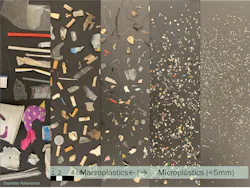
Plastics are durable synthetic polymers composed of a wide range of chemical additives. In the environment, larger plastic items degrade over time through physical, chemical and biological processes, fragmenting into smaller particles and releasing associated chemicals (Barnes et al., 2009; Mammo et al., 2020). These particles, known as microplastics, are defined as plastic materials smaller than 5 millimeters and larger than 1 micrometer, while particles below 1 micrometer are classified as nanoplastics.
Microplastics originate from both manufactured and degraded sources. Some are intentionally produced at small sizes, such as industrial resin pellets and microbeads used in products, while others result from the breakdown of larger plastics into fibers, fragments, foams and films (Wagner and Lambert, 2018).
Because of their small size and high surface area, microplastics and nanoplastics can both leach chemical additives and adsorb pollutants and pathogens, enhancing their ability to transport contaminants through the environment (Alimi et al., 2018; Eerkes-Medrano & Thompson, 2018). Many of the additives associated with plastics, such as bisphenols and phthalates, have been linked to endocrine disruption and other adverse health effects (Cox, 2019). Due to their growing environmental significance, microplastics were added to the U.S. EPA’s Contaminant Candidate List (CCL6) in April 2026. Microplastics and nanoplastics are now widely detected across global ecosystems, including food, beverages and drinking water. Increasing evidence shows that these particles can enter the human body through ingestion, with recent studies identifying microplastics in human tissues such as the placenta, liver, kidneys, brain and in both adult and infant feces (Zhang et al., 2021; Nihart et al., 2025).

Microplastics in urban water systems
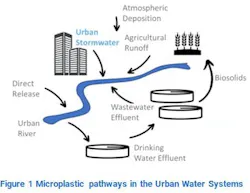
Urban water systems are a central conduit for the transport, transformation, accumulation and redistribution of microplastics within the environment. Microplastics enter these systems through multiple pathways, including stormwater runoff, combined sewer overflows and WRRFs influent originating from domestic, commercial and industrial sources. From there, microplastics are temporarily stored and redistributed between treated effluent, biosolids (sludge) and downstream receiving environments.
Nanoplastics — The smaller (and likely bigger) concern
While this article focuses on microplastics, nanoplastics can be safely assumed to be present wherever microplastics are found, as ongoing fragmentation produces progressively smaller particles down to the nanoscale. For many of the concerns associated with microplastics —such as the release of additives and their role as vectors for PFAS and other contaminants —nanoplastics are expected to pose an even greater concern due to their smaller size and higher surface area.
Nanoplastics remain significantly less studied, primarily due to the additional analytical burden. Detection in environmental matrices requires advanced techniques and extensive sample preparation, and this is particularly difficult in wastewater and sludge where high organic content challenges sample processing and particle detection. Despite these limitations, nanoplastics have been identified as ubiquitous and, in many cases, more numerous than microplastics, including in treated water streams. Research attention — especially in drinking water and health studies — is increasingly shifting toward the nanoscale fraction.
To date, public and regulatory discussions have focused on microplastics. The immediate challenge is to prepare a path for regulation, monitoring and treatment of microplastics, and doing so also reduces the nanoplastics burden that arises as plastics continue to fragment.
Microplastics and water resource recovery facilities
Wastewater contains large loads of microplastics, and U.S. publicly owned wastewater treatment plants collectively process approximately 34 billion gallons of wastewater per day (U.S. EPA, 2025). Depending on receiving sources of wastewater, influents can contain a combination of household fibers, as well as fragments from industrial and commercial discharges, especially plastic industries and other miscellaneous origins from the urban water systems (Sun et al., 2019).
The removal efficiency and pathway of microplastics in WRRFs varies highly with the treatment processes. Conventional WRRFs often remove more than 90% from the influent, primarily through physical settling, flotation and filtration processes (Talvitie et al., 2017; Carr et al., 2016). The various wastewater treatment processes temporarily accumulate and break down microplastics, and their presence may interfere with performance and efficiency (Nandakumar et al., 2022). In a conventional activated sludge (CAS) based WRRF, removal of up to 70% of microplastics was achieved by primary treatment and removal of 80–90% and 99% in the secondary and tertiary treatments occurred (Tang, 2021). Especially advanced, filter-based technologies, including biofilters, ultrafiltration (UF) and rapid sand filters (RSFs) have high microplastics removal efficiencies (Liu et al., 2021). The microplastics accumulate in the sludge, where concentrations are several orders of magnitude higher than those in treated effluent (Li et al., 2018). Due to the continuous and large volumes of wastewater processed and discharged and the potential runoff associated with biosolids land application, WRRFs are considered important pathways of microplastics in the urban water cycle (Murphy et al., 2016, Beni, 2023). Based on data of Tang and Haribarata (2021), 69-80% of microplastics in wastewater influent are maintained with the wastewater sludge. During sludge stabilization processes (e.g., digestion, thickening, dewatering), microplastics persist due to their resistance to biological degradation, and in some cases may fragment further into smaller particles. Mahon et al. (2017) measured microplastics in sludge from seven full‑scale wastewater treatment plants that use anaerobic digestion (AD), thermal drying (TD), or lime stabilization (LS) treatment processes. They detected thousands to over 10,000 particles per kilogram and observed that treatment type was influencing particle size distributions. Microplastics in sludge are dominated by fibers and fragments with diverse polymer types and sizes (Li et al., 2018; Mahon et al., 2017). A study across multiple facilities in Southern California reported very low concentrations in treated effluent (1 MP particle per ~1,100 liters) and 1 MP particle per gram in biosolids (Carr et al, 2016). Harley‑Nyang et al. (2023) reviewed global data on microplastics in sludge and biosolids; concentrations varied widely (0.193 to 1.69 × 10⁵ particles per gram).
When biosolids are land applied, microplastics are effectively transferred from urban wastewater infrastructure to soils and terrestrial environments (Corradini, 2019). Once applied to land, microplastics in biosolids can be mobilized through surface runoff, erosion, infiltration and wind transport. Particles may be reintroduced to urban stormwater systems during rainfall events, transported to streams and rivers, or migrate through soils with potential implications for groundwater quality (Rillig et al., 2017). This creates a feedback loop in which microplastics captured by wastewater treatment can be redistributed back into the aquatic environment through diffuse terrestrial pathways. Research on the fate of microplastics is needed to understand how chemical properties and structure of microplastics and nanoplastics affect their release into groundwater. Furthermore, the role of soil properties should be investigated to understand the fraction of microplastics and nanoplastics that are sequestered in soil vs are leached into groundwater or transported with runoff.

The impact on utilities
Microplastics present a systems‑level challenge for wastewater utilities, as treatment processes remove the majority of particles from the liquid stream but concentrate them in biosolids, where downstream management decisions determine their ultimate environmental fate. The high concentration of microplastics in biosolids provide an opportunity for streamlined management rather than allowing the pollutant to re-enter the water cycle through diffuse sources. Addressing this issue requires a clear understanding of microplastic behavior across treatment, sludge stabilization and reuse pathways, as well as the operational, regulatory and lifecycle tradeoffs associated with each option.
To effectively manage microplastics in wastewater and biosolids, utilities must take a more proactive, system‑wide approach that prioritizes upstream source control rather than relying solely on end‑of‑pipe solutions. Importantly, the burden of managing microplastics cannot rest with utilities alone; collaboration with regulators, manufacturers, and commercial and industrial contributors is essential to reduce inputs at the source. Utilities should therefore prioritize source control strategies — such as strengthening industrial pretreatment programs, engaging commercial and industrial dischargers — to reduce the volume of microplastics entering the system. Within treatment facilities, optimizing solids capture through enhanced primary and secondary treatment and advanced filtration can improve removal of microplastics efficiently while also minimizing fragmentation into smaller, more persistent particles that are more difficult to manage downstream.
To minimize microplastics in biosolids and reduce their redistribution to the environment, utilities should evaluate treatment and end‑use pathways through a lifecycle lens. Increased sampling and monitoring programs to better understand how technologies and operational strategies impact microplastic fate and transport will help the industry with management decisions. This includes understanding how stabilization processes may influence particle size and mobility, as well as how management options — such as land application, landfilling or thermal treatment — affect long‑term fate and transport. Targeted monitoring programs can help quantify microplastics across treatment stages and inform data‑driven decisions, while pilot testing of emerging removal or destruction technologies can support future implementation strategies. By combining source reduction, process optimization and informed biosolids management, utilities can begin to mitigate microplastics risks in a manner that aligns with regulatory expectations and long‑term system resilience.
Drawing on multidisciplinary expertise in wastewater process engineering, biosolids management and emerging contaminant assessment, Black & Veatch supports utilities in evaluating practical, data‑driven strategies that align treatment performance with long‑term environmental and infrastructure resilience.
About the Author
Charlotte Haberstroh
Dr. Charlotte Haberstroh, P.E., is a water resources engineer based in Tampa, Florida, specializing in microplastic pollution in urban water systems, as well as watershed planning and stormwater modeling. She has over ten years of experience in research and engineering and serves as Black & Veatch’s Microplastics Research & Strategy Leader. She earned her Ph.D. studying stormwater-driven plastic pollution in urban rivers and is dedicated to advancing solutions for emerging contaminants in the water industry.