Rethinking wastewater discharge into Snake River, Oregon
Key Highlights
- The new diffuser system features nine strategically arranged ports to maximize mixing and reduce ammonia impact on the Snake River ecosystem.
- Hydraulic modeling provided detailed insights, guiding the design to perform effectively under seasonal flow variations and depth fluctuations.
- Proco ProFlex duckbill check valves with low cracking pressure ensure reliable operation across a wide range of river conditions, enabling passive flow regulation.

The City of Ontario's 2-mgd wastewater treatment plant sits at a geographically significant point where the Snake River forms the border between Oregon and Idaho. Like many facilities of similar size in rural settings, Ontario relies on lagoon-based treatment before discharging into the river. This approach has served the community well, but the growing population and stringent environmental standards required a rethink on how it discharges the water.
The facility's original single-port outfall released treated effluent through a 24-inch pipe into the river. While this met previous standards, it proved insufficient for achieving rapid dilution and the necessary mixing to minimize ammonia impact on the Snake River ecosystem. With regulatory pressure mounting and population growth promising increased flows, Ontario needed a better solution.
The conventional response is often expensive treatment upgrades or a completely new outfall system extending further into the river. Instead, the project team took a different approach: optimize mixing efficiency through intelligent diffuser design.
Modeling before building
Before any equipment specifications were drawn or construction plans finalized, an environmental services consultant specializing in mixing zone analysis, created detailed hydraulic models of the discharge point. The modeling revealed specific insights about how effluent would interact with the Snake River under varying conditions: seasonal flow rates, depth fluctuations of up to 15 feet, and the river's natural mixing patterns.
Armed with this data, engineers developed multiple design alternatives, each featuring different numbers of diffusers, various arrangements, and different valve technologies. The winning design replaced the single 24-inch discharge with nine 8-inch ports arranged along a 31-foot section of high-density polyethylene pipe. This multiport approach immediately multiplies mixing points and increases the surface area where effluent meets river water.
Geometric precision meets hydraulic performance
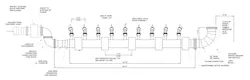
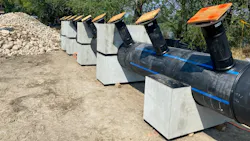
Each of the nine ports has a 22-degree elbow that pitches the discharge upward relative to the manifold. The valves themselves are then rotated at carefully calculated angles. The center valve points straight ahead at 90 degrees, while those on either side progressively fan outward, reaching maximum deviation of 60 degrees at the extremes.
This fanned arrangement creates overlapping mixing zones without requiring a longer manifold or larger footprint. This solution addressed practical constraints, such as the riverbed disruption, construction costs and operational simplicity, while maximizing hydraulic performance.
The new system is designed to handle up to 3 mgd, providing substantial headroom above Ontario's current 2-mgd capacity. The City planned to account for population growth and gave itself adequate room for an increase in capacity.
Valve design
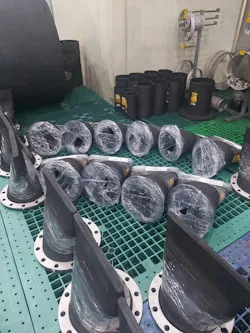
Diffuser design is only as good as the valves that control flow. This is where many systems encounter problems, particularly in variable-flow scenarios common to municipal wastewater treatment. Even though the treatment plant’s effluent is consistent it needs to function effectively whether the Snake River runs high or is sitting 15 feet lower during seasonal low-flow periods. The new check valves open reliably at minimal pressures and full-capacity flows regardless of river levels.
Standard check valves often require too much pressure to open or remain closed during low-flow periods that can create dangerous backups, or they lack the structural integrity to maintain consistent performance across wide pressure ranges.
The City used Proco ProFlex Style 710-E Flanged Duckbill Check Valves as they have exceptionally low cracking pressure - just 1 to 2 inches of head. This sensitivity ensures the valves respond to minimal flow if needed, opening partially to create high-velocity jets that drive effective mixing even when total discharge is minimal. When flows increase, the duckbill design passively opens wider, reducing hydraulic restriction and self-optimizing for changing conditions. This mechanical feedback loop, with no sensors, actuators, or controls, means the system can continuously adjust to hydraulic conditions.
Material science & customization
Equipment specification often focuses on mechanical design while underestimating material selection. For underwater diffusers, this mistake can lead to premature failure. The new valves use neoprene (polychloroprene) as their primary elastomer because it resists algae and barnacle accumulation, the primary failure mode for underwater diffusers. Barnacles wedging into valve openings prevent proper closure, allowing backflow and defeating the purpose of a check valve.
Neoprene also handles temperature extremes and environmental stressors that can degrade other materials over time. In an application designed for decades of service with minimal maintenance, this durability translates directly to lifecycle cost savings.
The valves required modification to match the engineer's geometric specifications. To address this, Proco fabricated custom internal bands allowing secure mounting on the angled elbows, and drilled bolt holes enabling the flanges to rest at 30-degree angles.
Smart, smooth construction

In the summer, effluent goes to irrigate farmland rather than the river. This created a perfect construction window that avoided service interruption. The first step was to remove the original outfall and then excavate the riverbed sediment, position the new manifold, and anchor it with concrete blocks. The area was then backfilled, all while the facility operated normally.
Ballard Marine Construction manually installed the nine check valves underwater, inspecting the entire assembly before the system went live. From design through installation, the project established how complex infrastructure upgrades can proceed with minimal operational disruption when properly planned.
Small and mid-sized municipalities often face the same regulatory pressures as larger systems, but with tighter budget constraints and less engineering support. Ontario's approach used smart design, precise hydraulic modeling, and appropriate equipment selection to deliver a sophisticated solution without a massive infrastructure overhaul and at a reasonable price.
The Snake River ecosystem is well protected as a result, and the City now has a diffuser system sized to serve the community for decades to come.
About the Author
 Cal Hayes
Cal Hayes
Cal Hayes is general manager at Proco Products.