Blending gray and green infrastructure for improved collection system performance
Key Highlights
- Green infrastructure includes rain gardens, bio-swales, green roofs, and detention ponds that mimic natural processes to manage stormwater at its source.
- Integrating green and gray solutions requires careful hydraulic modeling to ensure they complement each other without counteracting effects, especially during varying storm events.
- Advanced hydraulic models now incorporate green infrastructure components, enabling more accurate system-wide simulations and better planning for urban water resilience.

Sewer systems have long been the backbone of urban developments. Human health and environmental stewardship blossomed alongside functional, efficient collection systems. To quote Joseph Bazalgette, the engineer who designed London’s main drainage system in the 1800s, “the principle in building a sewer system is diverting the cause of the mischief to where it can do no mischief.”
What constitutes mischief in the twenty-first century has, however, evolved from Bazalgette’s days. Modern water resources engineers might say mischief constitutes regulatory expectations, urban flood risk reduction, inflow and infiltration, aging infrastructure, receiving water quality, urban growth, climate change uncertainty associated with intensifying rainfall patterns, and community pressure for more sustainable solutions.
To combat the myriad of challenges, engineers have become more creative in how they design and implement urban wet weather and stormwater solutions. One approach that is increasingly being adopted is blending of green and gray infrastructure. Throughout the last two decades, urban environments have seen an increase in the construction of green infrastructure to augment more traditional gray solutions. The inclusion of green infrastructure has changed engineering design strategies and how hydraulic models are utilized. In this article, let’s look at how engineers are adapting their approaches to embrace integrated gray and green infrastructure solutions.
Hydraulic impacts on collection systems

Gray infrastructure is the general term for the traditional collection system upgrades, encompassing pipes, pump stations, and storage tanks. Green infrastructure, which comprises solutions that mimic nature such as rain gardens, bio-swales, green roofs, and detention ponds, has evolved from a niche stormwater enhancement to a core component of modern wet weather planning.
Gray and green solutions are both designed to deal with runoff from roads, roofs, sidewalks, and other impervious areas. The main challenge when planning and designing integrated gray and green infrastructure solutions, however, is that they manage wet weather in vastly different ways.
Gray infrastructure upgrades are deployed within collection systems and intercept flows that are already in sewers. Furthermore, gray solutions focus on increasing conveyance capacity during larger storms or storing peak runoff flows, which are subsequently released once capacity becomes available after the storm has passed. Green solutions intercept runoff at the surface, before it can enter the sewer system. Green infrastructure is based on two hydraulic functions: reduce the amount of runoff that flows into a collection system, and/or reduce the rate at which the runoff enters the sewers.
When considering integrated solutions, green benefits are most consistently observed when reducing peak inflows during smaller, more frequent storm events, whereas gray infrastructure is designed for extreme conditions. Gray solutions intend to fill the sewer as efficiently as possible, while green solutions inherently reduce and slow runoff into sewers. Integrating the two requires making sure one does not counteract the effect of the other.
Creating design strategies and prioritizing solutions
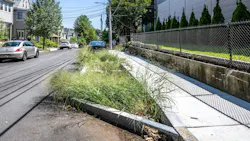
Where engineering solutions are to be investigated, all projects consider solution feasibility and preference. Feasibility considers achieving regulatory requirements, constructability, and land availability, whereas preference considers customer service expectations, familiarity, innovative technologies and utilization of public private property solutions.
To find the “best-fit” integrated gray and green infrastructure, the most common approach is to create test scenarios to compare outcomes under a range of wet weather conditions. While not commonplace, many wastewater utilities across the globe are modeling the hydraulic impacts of gray and green infrastructure on a system-wide scale to address conveyance capacity, infiltration and inflow reduction, and to mitigate combined sewer overflows.
Hydraulic modeling techniques have evolved to assess additional needs of green infrastructure such as peak flow attenuation, extended routing times, and seasonally varying infiltration. Several commercially available hydraulic modeling software packages include green infrastructure components that recreate the hydrologic and hydraulic characteristics of individual green infrastructure structures. These components allow for modelling green infrastructure alongside gray components.
This means that green infrastructure can be modeled with the same levels of accuracy and understanding as sewers and more importantly can be augmented to existing hydraulic models. When decentralized green infrastructure modeling can replicate the hydrological effects through adjusting infiltration, local detention volumes, and release characteristics on city blocks or individual properties, the approach is considered successful at a micro scale. To be truly accurate, however, each green infrastructure component must be accurate collectively, too—intercepting runoff before entering the sewer system. By intercepting runoff at a macro scale this ensures that green infrastructure performs complementary to, not disruptive of, the underlying sewer model hydraulic performance.
When evaluating green infrastructure city-wide or at a macro scale, engineers could also apply a more deterministic hydraulic model. This type of model involves applying rainfall depths directly to a two-dimensional surface mesh created from a digital terrain model. Adjusting variables to reflect surface types and land use can better represent accurate runoff routing and infiltration parameters. Deterministic models also factor in manholes and catch basins where flows enter a sewer system, much like they do in any urban area. Closer to reality, certainly, but increasingly data hungry. This approach is also supported by commercially available software, including some packages which include green infrastructure components.
One note of caution is that deterministic models can calculate runoff differently than probabilistic sewer models. Model calibration ensures that runoff generation, routing, storage, and conveyance processes are realistically represented. Therefore, if a previously calibrated probabilistic hydraulic model is repurposed to include deterministic flows, the parameters originally applied are redundant. To ensure continuity, once the green infrastructure components are added, the original calibration should be revisited to ensure consistency.
Measuring outcomes and continuous improvement
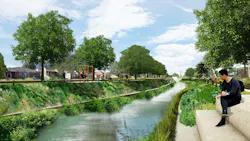
Planning and designing green infrastructure require monitoring and adapting based on findings. Wastewater and stormwater utilities generally measure outcomes with one or more of the following approaches:
- Direct monitoring: Flow meters upstream/downstream of green infrastructure components
- Event-based tracking: Combined sewer overflow (CSO) volumes, durations, and frequencies
- Model–monitor reconciliation: Blending Supervisory Control and Data Acquisition (SCADA) observations with predicted hydraulic model simulation results.
Monitoring gray infrastructure is extensively deployed using flow metering and SCADA sensors. CSO measurements and inflow and infiltration quantification has been ongoing for decades. More recent gray and green combinations, however, are being tested together as composite or holistic solutions. Modern SCADA systems incorporate advanced analytics to detect trends, anomalies, and long-term performance. In conjunction with cost effective green infrastructure monitoring via flow, or level sensors, these analytics use existing SCADA systems for real-time, and near real-time performance tracking. New SCADA testbeds can simulate decentralized system behavior and evaluate control logic for green operations (e.g., release rates, smart valve positions).
Successful outcomes require meaningful measurements. Understanding the impacts of any gray or green solution requires monitoring at permitted or problem locations to gauge the solution’s effectiveness. Measuring depth and velocity downstream of a structure can show the solution’s performance as well. For a complete picture, and to help identify the most cost-effective future implementations, upstream measurements and structural depth measurements for detention solutions add valuable long-range data.
Green infrastructure as a core tool
As utilities modernize their wet weather strategies, green infrastructure is no longer an optional enhancement but a core tool for resilience, regulatory compliance, and system performance. Blending green and gray infrastructure, when grounded in robust modeling, monitoring, and measurement, helps utilities reduce combined sewer overflows, reduce infiltration and inflows, mitigate flooding, enhance system resilience, and meet regulatory expectations while delivering environmental and community benefits. Further expansion of SCADA and monitoring systems to capture green impacts will only inform future adoption of green infrastructure.
As urban growth continues, and collection systems battle the sands of time, sewers will remain the backbone of healthy and water-enhanced lifestyles. In blending with green infrastructure, they now have a trusted partner to help deal with urban water mischief.
About the Author
 Nick Anderson
Nick Anderson
Nick Anderson is a vice president at Stantec, as well as the firm’s North America sector leader for Stormwater Management, Collection Systems, and Combined Sewer Overflows. He has close to 30 years of experience working on sanitary, combined, and stormwater projects, from strategic planning to detailed design.