Let there be light! Using distributed temperature sensing to spotlight inflow and infiltration sources in sewer systems
Key Highlights
- DTS technology uses fiber optic cables and laser light reflections to measure temperature variations along sewer pipes with high spatial and temporal resolution.
- The technology helps identify specific sources of I/I, such as private property connections and foundation drains, enabling targeted and cost-effective repairs.
- Pilot projects in California and Milwaukee demonstrated DTS's capability to monitor sewer systems during storm events and provide actionable data for infrastructure improvements.
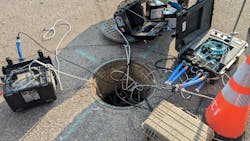
Excess water that finds its way into sanitary sewer systems can cause big problems for system owners, including sewer system overflows (SSOs), sewer backups and violations of treatment plant discharge permits. Many system owners use extensive and expensive programs to find where surface runoff (or inflow) and groundwater (or infiltration) are entering the sewer system. Locating specific causes of this inflow and infiltration (or I/I) can lead to very cost-effective wet weather flow reductions and increased confidence in eliminating these problems.
The wastewater industry has been working to find and implement I/I solutions for as long as there have been sewers, but the approaches and technologies are constantly changing. A recent innovation using existing technology to identify I/I with temperature monitoring could make a big difference in helping fine-tune I/I reduction programs.
DTS technology and I/I application
Distributed Temperature Sensing (DTS) consists of two things: a laser light emitter/receiver and a fiber optic cable. Laser light reflections can be processed using the Rahman backscatter effect to determine the temperature at a specific location on a fiber optic cable at a specific time. This technology is used in many industries including oil exploration, fire protection, pipeline leak monitoring and water resources studies. DTS is a technology worth considering in any situation in which time and space-specific temperatures can provide insights into important behaviors.
In sewer systems, specifically, DTS is useful because I/I can dramatically change the temperature of wastewater in sewer pipes. This is because nearly all flow monitoring devices can detect wastewater temperature in addition to depth and velocity of the flow. Whether the wastewater temperature increases or decreases during a wet weather event is due to numerous factors including local weather, time of year, the amount of background wastewater at any given time and the depth of the sewer system. Because DTS is capable of high-resolution data acquisition (e.g., every meter and every minute), this method generates an incredible amount of data useful for learning many important aspects of a sewer system, including where sewer laterals from homes and businesses are connected and whether they are responsible for conveying I/I.
DTS has been used for studying I/I in many countries outside of North America, mostly in Europe and New Zealand. European research institutes have regularly been using DTS for water resources studies and explored using it for finding I/I in sewer systems and illicit wastewater sources in storm sewer systems in the early 2000s. Through these published case studies and papers, Brown and Caldwell considered adapting DTS for use in the United States with several key clients.
Proof of concept – EBMUD goes first
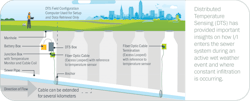
Through a pilot project launched with East Bay Municipal Utility District (EBMUD), headquartered in Oakland, California, Brown and Caldwell performed the first known U.S.-based temporary DTS monitoring system on a group of sewers in one of EBMUD’s satellite collection systems. The Public sewers and maintenance holes in this area had been previously rehabilitated, but recent flow monitoring indicated persistently high levels of I/I, suggesting that private property sources may be the most likely culprits. A DTS monitoring system was installed in late January 2020 with the intent of monitoring and providing convincing data from three expected 1-inch rainstorms. Unfortunately, abnormally dry weather conditions prevented the identification of the specific source(s), but the system Brown and Caldwell installed proved capable of gathering sewer system temperature data. This was an important step for bringing DTS to U.S. sewer systems and, recently, EBMUD awarded Brown and Caldwell a competitive on-call contract for performing additional DTS monitoring.
“DTS provided a unique viewpoint within a sewer main to identify variations in flows,” says Chris Dinsmore, P.E., Senior Civil Engineer, EBMUD Inflow and Infiltration Control Program. “EBMUD intends to trial the investigative methodology further, if appropriate field conditions are identified.”
Building capability – MMSD investigates foundation drains
The Milwaukee Metropolitan Sewerage District (MMSD) in Milwaukee, Wisconsin, has had a regional private property I/I (PPII) reduction program in place since 2011. MMSD has used the program to guide and fund a variety of efforts to reduce PPII in its service. MMSD dedicates a portion PPII program budget toward research and innovation, so MMSD was very interested in trying DTS to better locate properties that are responsible for significant I/I.
“One of the key advantages of DTS is its continuous operational readiness—once installed, the system automatically collects data during unplanned or infrequent wet weather events,” says Becky Specht, P.E., MMSD Urban Water Program Manager. “This capability provides timely, high-resolution information that supports targeted rehabilitation efforts and helps prioritize repairs with the greatest impact on system performance.”
One particularly tricky source of I/I building foundation drains that were connected to sewer laterals prior to a plumbing code change in 1954. DTS was used by Brown and Caldwell to monitor a street in the City of Wauwatosa where previous improvements had fixed the entire public system and sewer laterals up to the house, meaning the only remaining source was the foundation drain. The summer 2020 study period coincided with some significant storm events that yielded very useful DTS data. The analysis indicated that a small number of homes on this street were consistently generating the majority of I/I in the area. It also concluded that I/I temperature varies from event to event, and even throughout an individual event due to dynamic weather conditions and the heat content of the rain itself. These variations are necessary to account for when using temperature to estimate specific quantities of I/I input at locations of interest.
Pinpointing specific I/I improvements - HRSD’s highly focused program
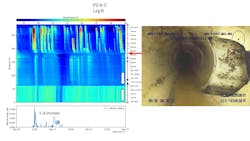
The Hampton Roads Sanitation District (HRSD) in Virginia Beach, Virginia, agreed to a modified U.S. EPA Consent Decree in 2020. This required the implementation of a Regional Wet Weather Management Plan, which included performing I/I reduction improvements in the local sewer systems and possibly on private properties. Since these I/I improvements are intended to be performed only where they will reduce capacity-related wet weather SSOs, HRSD was naturally very interested in any technologies and approaches that would lead to razor-sharp recommendations focused on cost-effective flow removal. Brown and Caldwell has implemented DTS in four separate areas in HRSD’s system to date, resulting in highlighting specific fixes for significant I/I sources.
“Reviewing the DTS with Brown and Caldwell for the four areas within the city was very interesting,” says Phil Hubbard, P.E., HRSD Senior Project Manager. “It showed areas of private lateral issues and provided a very noticeable rain event temperature response in an area where a building had been removed. We will track these items down and reduce I/I from the system causing SSOs.”
Brown and Caldwell is currently implementing DTS through an alternative delivery contract held by Burns & McDonnell in Kansas City, Missouri, along with other subconsultants and contractors, RJN and Dukes Root Control. Rehabilitation actions soon will be taken on a set of these recommendations, which can later be re-monitored for a thorough effectiveness evaluation.
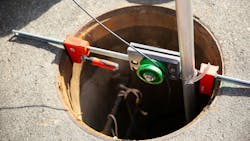
Conclusion
Starting with a “proof of concept” to now providing actionable findings, these case studies demonstrate how DTS can help utilities and municipalities better focus their scarce I/I reduction budgets. DTS is among emerging technologies that could lead the industry toward more effective results, including more resilient systems and protection from additional regulatory pressure.
About the Author
Andy Lukas
Andy Lukas is the Wet Weather National Practice Leader for Brown and Caldwell, providing comprehensive wet weather solutions for wastewater systems, addressing regulatory pressures and enhancing compliance.
Rhys McDonald
Rhys McDonald is a Managing Principal Environmental Scientist with Brown and Caldwell, with extensive experience customizing environmental instrumentation and telemetry systems for wastewater systems.