Delaware Plant Earns Award for Compliance Record
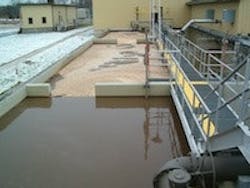
In August 2012, the Lewes Board of Public Works (BPW) earned the Delaware Department of Natural Resources and Environmental Control’s (DNREC) Clean Water Partnership Award. The award recognized the performance of the Howard H. Seymour Water Reclamation Plant in Lewes, Del.—an Atlantic Ocean beach community of 3,000 residents and an additional 10,000 people during tourist season. The plant is operated by De Nora Water Technologies through a public-private partnership.
The award had not been given for several years due to its demanding criteria. It recognizes facilities that for five consecutive years have reported no non-compliances in the monthly discharge monitoring reports required under their National Pollutant Discharge Elimination System permit.
So, how did a Delaware plant achieve five consecutive years with not one violation?
Correcting Elevated Discharge Levels
In 2005, the Lewes board decided to upgrade the Seymour plant in response to the U.S. Environmental Protection Agency’s investigation into elevated wastewater discharge levels at the facility and to increased loadings experienced during its tourist season. Completed in 2008, the upgraded plant’s operations were led by plant manager Walter Baumer, since retired, and assistant plant manager Lori Brown, now the plant’s manager.
The expanded Seymour plant’s capacity doubled from 0.75 million gal per day (mgd) to 1.5 mgd and features a membrane bioreactor process (MBR)—the first of its kind in Delaware. The MBR combines ultrafiltration membrane technology with biological treatment followed by UV disinfection. The result is extremely high quality effluent that conforms to the stringent standards required for discharge into the Lewes Rehoboth Canal. Effluent concentrations of biochemical oxygen demand and total suspended solids average less than 1 mg/L, compared to the facility’s permitted levels of about 16 mg/L.
Teamwork & Dedication
Brown cited the dedication of the plant’s operations, maintenance and lab personnel for much of the plant’s successful operation.
“The Seymour plant and 32 lift stations are operated and maintained by a staff of just four people. When flooding or a hurricane has threatened the plant’s operation, we’ve spent the night when necessary in order to address any issues. We try to go above and beyond, even delivering our monthly discharge monitoring reports two weeks before they are due,” said Brown.
According to Glenn F. Davis of the DNREC, “The Clean Water Partnership Award is especially significant when you recognize that every month there are 160 opportunities for the treatment plant to be out of compliance; that is just under 2,000 per year. During the five years covered by this award, that equates to approximately 9,600 opportunities, and the Lewes board had ‘zero violations’. This is quite an achievement.”
According to Brown, perhaps the ultimate compliment of the Lewes BPW/De Nora Water Technologies partnership is the words of another Delaware wastewater plant manager.
“He told me he uses the Seymour plant as the standard against which he judges his plant’s success,” said Brown. “That’s high praise.”
Speaking of the public-private partnership with De Nora Water Technologies, Darrin Gordon, general manager of the board, said, “We have contracted with [De Nora] for many years. We feel our contract is treated more like a partnership than an owner/vendor relationship. With the partnership approach, we have held O&M costs in check while producing excellent effluent—a combination that is largely responsible for our receiving the Clean Water Partnership Award.
Protecting the Environment
The Seymour plant’s improved performance also helps protect Delaware’s Inland Bays and saves money by preventing the need to construct a more costly means of effluent discharge. The DNREC had issued a total maximum daily load for nitrogen and phosphorus for a nearby shallow coastal lagoon system that required the systematic elimination of all point sources from inland waterways. While the majority of the Seymour plant’s discharges enters the Delaware River and flows to the Atlantic, some of the discharges could back up and go into the lagoon, which would have required a switch from liquid discharge of the plant’s effluent to spray irrigation, ocean outfall or deep well injection. Plant personnel conducted a dye study and found that only 3% of its effluent flow makes it back into the bay. Given the upgraded plant’s high quality effluent, the state allowed the plant to continue its liquid discharge, saving millions of dollars.